Divorce Statistics


There are always lots of emotions that come up whenever we talk about divorce. In life, sometimes you do win, but other times you get knocked down. The following are some of the statistics surrounding divorce. We want to help remove the fear of divorce so you can learn the facts. Being an RCS-D, Real Estate Collaboration Specialists - Divorce we provide compassion and guidance for all your needs as you go through the process of divorce. Although it can be scary and overwhelming youre not alone and dont have to be.
1) 41% of First Marriages End in Divorce
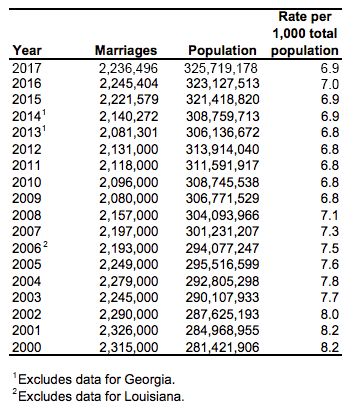
*The provisional number of marriages and rate in the United States (2000-2017)
2017 is the most recent year for which statistics are available. So the biggest Statistic is that researchers estimate that approximately 41% of all first marriages end in Divorce.
The Total number of Marriages divide by the total population.
Number of marriages: 2,245,404
Marriage rate: 6.9 per 1,000 total population
Many Factors go into the divorce rate being so high.
Over the years, researchers have determined certain factors that put people at higher risk for divorce: marrying young, limited education and income, living together before a commitment to marriage, premarital pregnancy, no religious affiliation, coming from a divorced family, and feelings of insecurity, and young age all contribute to the high divorce rates.
2) The Average Length of a First Marriage is About 8 Years.
The average duration before a marriage terminates is 8 years. The median duration of second marriages that ended in divorce was about the same as for first marriages for women, at 8 years, but longer for men at 9 years
Another interesting statistic is 86% of people contemplate getting a divorce for 1 year before they ever file for Divorce,
3) The Average Total Cost of Divorce in the United States is Approximately 15,000.
Due to the high cost of divorce, selling your home before the divorce is finalized may offer you the financial freedom to deal with other financial obligations and debts.
Furthermore, after a separation, it may no longer be affordable to maintain the home. This is another reason couples decide to sell their home.
It is good to know that you have control over the property you own if you decide to divorce.
We can contact you with like-minded attorneys.
4) Approximately Five Percent of Divorces are Settled in the Courtroom.
This means in 95 percent of divorce cases, the parties and their family law attorneys are able to settle issues amicably or in mediation. The good news about divorce and making a decision about the property you own is that you are in control of your biggest asset.
Together, we can help you make an informed decision to keep the house or not based on affordability. We want you to know what you can afford after the divorce.
It is pertinent to gather real estate documents in the discovery phase as decisions made during mediation are final. Dont delay!
Keep The House For The Right Reasons
Download a Free Informational Resource, Protect Yourself & Get The Facts!
5) 90% of Divorced Mothers have Custody of their Children.
Statistics are frequently cited suggesting around 90% of women are awarded custody, but they also fail to show that 60% of men get custody in contested cases. Similarly, in just over half of all divorce cases, the parents mutually decide that the mother will take the custodial role. Moreover, when child custody decisions rest in part upon gender, fathers may unfairly lose custody battles as a result of firmly held traditional notions.
The most common form of child custody is sole custody. Here, either the mother or father is the sole custodial parent of the children, while the other parent maintains visitation rights.
Reasons why women get primary or sole physical custody of children in a divorce more often than men can vary from one case to another, but it is true that courts all across the United States tend to be biased against men when awarding child custody for a variety of reasons.
For better or worse, culture plays a predominant role in determining child custody. From a cultural and historic perspective, women have always been considered superior parents based on a questionable assumption that infants and young children would not be able to survive without a mother since men cannot nurse and breastfeed babies.
Why Do Some Choose To Sell the Family Home?
If real estate is involved, you might ask yourself, are we keeping the home or selling the home? or what are my options with the house? There are benefits to selling the house in the midst of the divorce process, both financially and personally. The profit gained from the sale of your home might provide each spouse with a solid foundation to start anew. Selling the marital home and eliminating that shared investment can also help to provide closure in a legal and emotional aspect.
6) Half of All Children in the United States will Witness the Ending of a Parent’s Marriage.
The impact on children is real and each child and each family are obviously unique, with different strengths and weaknesses, different personalities and temperaments, and varying degrees of social, emotional, and economic resources, as well as differing family situations prior to divorce. Despite these differences, divorce has been shown to diminish a childs future competence in all areas of life, including family relationships, education, emotional well-being, and future earning power.
Each spouse should pre-qualify for a mortgage before the divorce is final. Sometimes, a divorcing couple will decide that one spouse is going to keep the house. They take the other spouse’s name off the deed – and then the spouse who wants to keep the house gets turned down for a mortgage because he/she doesn’t make enough money to qualify to refinance in his/her name alone. The spouse who is leaving the marital home ends up being on the hook for the debt has no reciprocal asset, and can’t qualify for his/her own mortgage because he/she doesn’t make enough to support both mortgages.
One question you might be asking is can I get a mortgage now?
To qualify for a mortgage, most conventional lenders use credit and debt to income ratios. Many use a credit score system to qualify applicants; a credit score is based on payment history, amount of credit owing, length of time credit established, number of recently opened credit accounts and types of credit established. Lenders generally use two different ratios to analyze creditworthiness.
There is a chance that a lender won’t approve one spouse on their own, especially if you are a non-earning spouse, whose income is solely made up of small alimony and child support payments. We can help get you connected to local Divorce Lenders that will be able to help answer your questions.
7) 43% percent of children in the United States are Being Raised Without Their Fathers.
Children from fatherless homes are more likely to be poor, become involved in drug and alcohol abuse, drop out of school, and suffer from health and emotional problems. Boys are more likely to become involved in crime, and girls are more likely to become pregnant as teens. Some fathering advocates would say that almost every social ill faced by America’s children is related to fatherlessness. See the related fatherlessness epidemic infographic.
8) 65% of divorced mothers receive no child support.
Can I Afford the Monthly Costs?
You will need to step back and look at all of your monthly costs to live. Your biggest payment is usually housing, followed by transportation, and then food. Those 3 combined typically account for 70% of expenses.
Calculating the mortgage and looking at the total cost of a home is important in determining if you can truly afford the home. Adding up all ongoing hidden costs, such as real estate taxes, maintenance costs, utilities, and insurance, etc. A common rule of thumb is for homeowners to budget at least 1% of the value of their home for annual maintenance costs. If your home is worth 400,000, you will budget at least 4,000 per year or 333 per month for home repair costs.
Keep in mind that child support and alimony will eventually run out but the mortgage you sign up for is usually 30 years. Once you know that you can afford you can look if you need to downsize or if you can try and buy your ex out, you must dust off your calculator and make sure that you can easily handle the monthly costs.
9) After a Divorce, Almost 50% of Parents With Children Move into Poverty.
Families with children that were not poor before the divorce see their income drop as much as 50 percent. Almost 50 percent of the parents with children that are going through a divorce move into poverty after the divorce.
We have both been down this path before, and we can assist you in navigating through the unknowns. We work hand-in-hand with clients to help ease stressful real estate transitions, whether you keep the home or not.
The Gifford Group Helps Keep You Protected and Informed During Divorce By:
Connecting you to the right people and assist in finding a new house or rental in the same school district.
Helping to maintain Good Credit for both spouses.
Preserve Homeownership Eligibility.
Provide referrals for local lenders to help with a refinance or spouse buy-out.
Gather Real Estate Documents For Informed Decision Making.
10) Women are the Ones Who Most Often File for Divorce 69% of the Time.
Women initiated 69 percent of all divorces, compared to 31 percent for men. In contrast, there was not a statistically significant difference between the percentage of breakups initiated by unmarried women and men, regardless of whether they had been cohabitating with their partners. That figure has soared to nearly 75 percent in some years.
Women are more likely to feel held back by their marriage.
Today, women work more than ever and make up just over half of the workforce in the United States. In many marriages, women are still primarily responsible for household duties. They still have a lot on their plates with their careers.
Women often shoulder more of the emotional burden.
Every marriage begins with communication, but it is often an area where couples struggle. Men generally arent taught how to express themselves or process their emotions. Due to this, women often shoulder more emotional responsibilities in marriages. In some cases, this may also include providing family members with the only emotional support.
11) The Average Age for Couples Going Through Their First Divorce is 30 Years Old.
Youre twice as likely to get divorced if youre under 24 years old. Divorce is influenced by three factors: age, income, and education. Despite the fact that all of these variables work together in tandem to influence the success or failure of a marriage, the one factor which stands out is age. 60% of marriages between 20 and 25 years old end in divorce.
In 2015, 21 adults ages 40 to 49 divorced per 1,000 married persons in that age range – up slightly from 18 in 1990. By contrast, the divorce rate for adults ages 25 to 39 has fallen from 30 persons per 1,000 married persons in 1990 to 24 in 2015. This decline is attributed at least in part to younger generations putting off marriage until later ages. The median age at first marriage for men in 2016 was 29.5, and for women, it was 27.4 – up from 26.1 and 23.9, respectively, in 1990. In addition, those who do end up marrying are more likely to be college-educated, and research shows that college-educated adults have a lower rate of divorce.
12) 60% of All Divorces Involve Individuals Aged 25 to 39.
According to a recent report, 60% of divorces involve spouses between the ages of 25 and 39. The divorce rate for people over 50 has doubled since 1990, despite the average age of 30. The mental and financial toll of a grey divorce can be significant. According to one study, people who experienced a grey divorce experienced worse depression than those whose partners died.
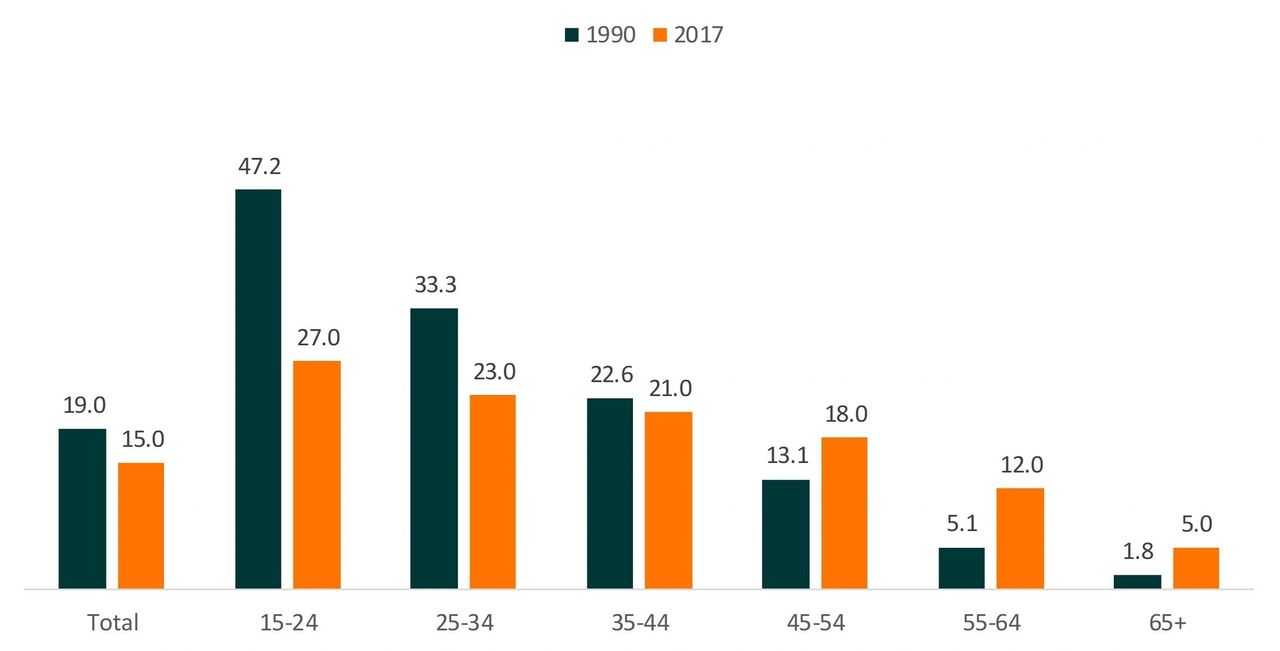
Source: Centers for Disease Control and Prevention, National Center for Health Statistics, Vital Statistics and U.S. Census Bureau, American Community Survey, 2017
The Gifford Group Helps Uncover All The Unknowns During Divorce
- What is my home worth?
- Can I Keep the current house?
- How much will I profit if we sell?
- Is your Home Uninsurable, due to past claims?
- Can I Afford a new house?
TheGiffordGroup.net - Opening Doors To New Beginnings
#divorce
#divorceStatistics
#divorcesupport
#marriage
#thegiffordgroup
#houstonhomespecialist
#openingdoorstonewbeginnings
#realestate
#houstonrealtor
 If you enjoyed this post, please consider sharing it with others.


Categories of Topics Amber Gifford Has Written About
Home Selling Mortgage & Finance Education Home Buying Home Improvements & Repair Housing Market Home Builders Home Appraisals Foreclosures & Investments General Home Inspections Houston Living Affordable Housing Property Taxes Master Planned Communities Neighborhoods & CommunitiesAmber Gifford’s Blog Archive



 Saved
Saved