Sign In
Create an account and enjoy all the benefits of HAR.com!
Sign In
Sign in using social account


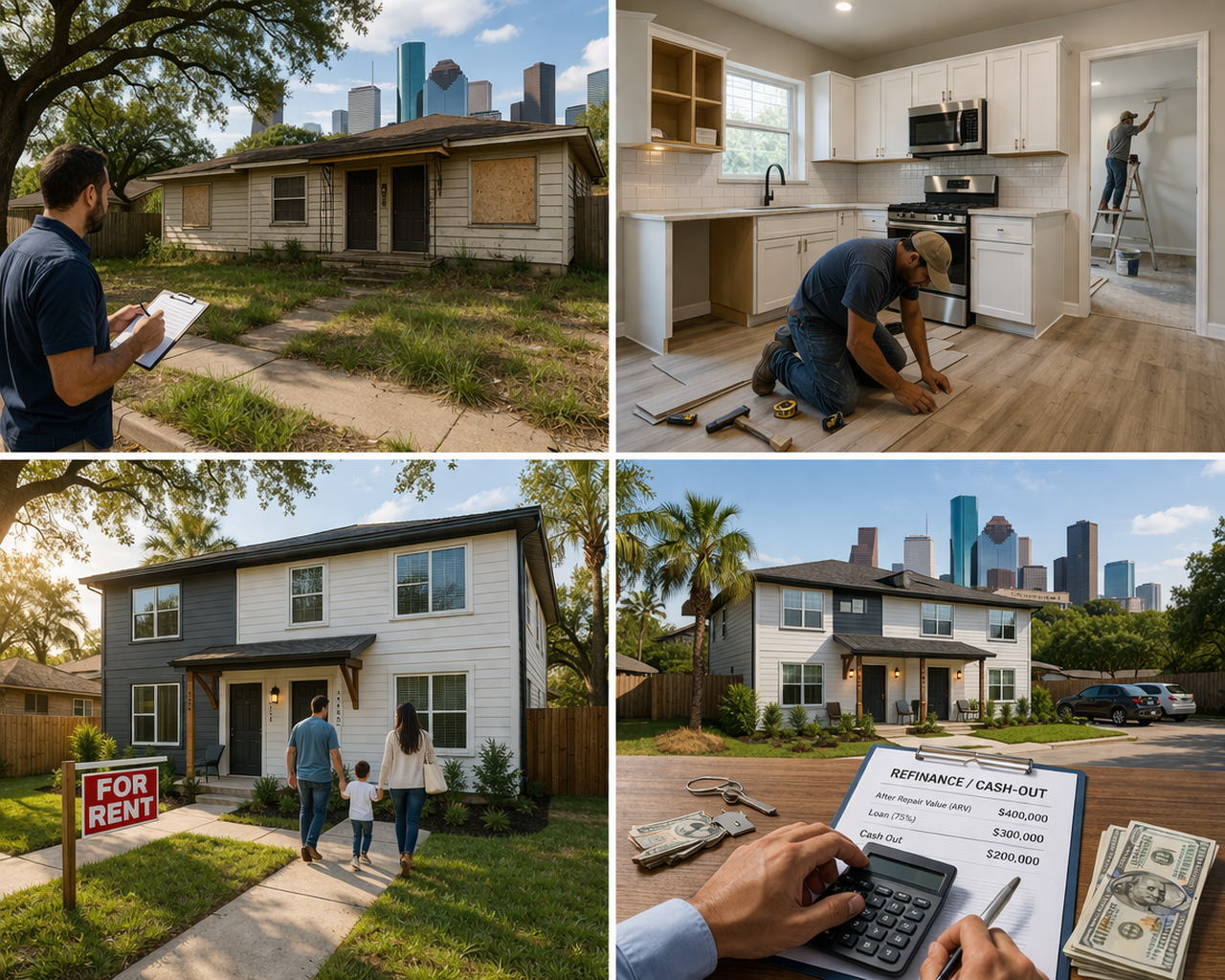
Houston has long been one of the most investor-friendly cities in the United States. No state income tax, a growing population, a massive job market anchored by energy and healthcare, and home prices that still offer real opportunity make the Bayou City a prime location for building wealth through real estate. One of the most effective strategies working in the Houston housing market right now is BRRRR. If you are a buyer, investor, or military veteran exploring your options, this guide breaks it all down.
What Is the BRRRR Strategy?
BRRRR stands for Buy, Rehab, Rent, Refinance, Repeat. It is a real estate investing method designed to help you grow a rental portfolio without needing a fresh down payment for every single property you want to acquire.
Here is the core idea: you purchase a distressed or undervalued property, renovate it to raise its value, rent it out to generate monthly income, then use a cash-out refinance based on the new appraised value to pull your capital back out. That recycled capital goes toward your next deal. Then you do it again.
Traditional buy-and-hold investors often wait five to seven years to save enough for a second property down payment. With the BRRRR method, that same capital can potentially fund three or four acquisitions in the same window.
Why Houston Is a Strong Market for BRRRR
Houston checks almost every box for a successful BRRRR investment environment.
The greater Houston metro added over 100,000 new residents in 2024 and 2025, and that migration trend has not slowed down. Population growth keeps rental demand strong, which means finding tenants after a rehab is not typically a problem in well-chosen submarkets.
Texas has no state income tax, strong property rights laws, and a streamlined eviction process that protects landlords. These structural advantages make owning rental property here more profitable than in many other major cities. Single-family homes in suburbs like Katy, Pearland, and Sugar Land show tight vacancy rates, especially from families relocating for energy, medical, and aerospace jobs.
Houston also remains significantly more affordable than Austin and Dallas. That affordability gap continues to drive migration into the city and keeps demand for workforce housing strong at the price points most BRRRR investors target.
Step One: Buy the Right Property
The foundation of any successful BRRRR deal is finding a property priced below its potential. You are looking for distressed homes, probate sales, properties that need cosmetic or structural work, and homes priced below neighborhood comps.
Houston has no shortage of these opportunities. Neighborhoods like Sunnyside, Independence Heights, Third Ward, East End, and parts of North Houston still offer entry points where you can acquire a property, put in real work, and manufacture equity rather than waiting for the market to do it for you.
A useful rule in BRRRR underwriting is the 70 percent rule. The formula is straightforward: After Repair Value multiplied by 70 percent, minus your estimated rehab costs, equals your maximum offer price. If a Houston home will be worth $200,000 after renovation and needs $30,000 in work, you should not pay more than $110,000 for it. This formula protects your margin and sets up the refinance to work in your favor.
Step Two: Rehab to Force Appreciation
The rehab phase is where BRRRR investors create value that the market did not price in at purchase. In Houston, effective rehabs typically focus on kitchens, bathrooms, HVAC systems, roofing, and foundational repairs.
Houston's older housing stock, particularly in Inner Loop neighborhoods like Third Ward, Eastwood, and the Near East Side, often has deferred maintenance issues including foundation settling and aging electrical. Budget for these specifically. Undiscovered costs in the rehab phase are the most common reason BRRRR deals underperform.
Work with licensed contractors, pull permits, and document everything. Lenders who will refinance the property after the fact will want to see that renovations were done correctly. Documented improvements also support a higher appraisal, which directly impacts how much capital you can pull out during the refinance step.
For timeline planning, most Houston BRRRR investors target a two to five month rehab window. Projects that run long or over budget compress your returns and delay your refinance, so conservative cost estimates matter.
Step Three: Rent to Stabilize the Asset
Once the rehab is complete, you need a qualified tenant in place before most lenders will process a cash-out refinance. This stabilization period is a critical part of the process.
In Houston, rental demand remains strong across the board. The Texas Medical Center is the largest medical complex in the world and continues to expand. The energy sector continues to employ hundreds of thousands of people across the metro. Families relocating from California, New York, and Illinois are arriving in steady numbers and need housing.
Neighborhoods near employment hubs tend to lease up fastest. Properties in Pearland or Katy targeting families in the energy corridor tend to have low vacancy. Properties in EaDo, Midtown, or Spring Branch targeting young professionals or medical workers also move quickly.
Price your rent using current Houston market data rather than guessing. A strong tenant at a solid rent rate gives you two things: monthly cash flow and a lender-ready, stabilized asset for the refinance.
Step Four: Refinance and Pull Capital Back Out
This is where the BRRRR strategy separates itself from a standard flip or buy-and-hold. After the property is renovated and rented, you apply for a cash-out refinance based on the new appraised value.
Most lenders will loan up to 75 percent of the current appraised value on an investment property. So if you bought a Houston home for $110,000, rehabbed it for $30,000, and it now appraises at $200,000, a lender at 75 percent LTV would issue a $150,000 loan. After paying off your original purchase financing, the remaining cash comes back to you.
That returned capital funds your next acquisition. You still own the property. You still collect rent. You have simply recycled your equity rather than leaving it locked in.
A few things to plan for in Houston specifically: lenders typically require six to twelve months of seasoning before a cash-out refinance on an investment property. Budget for two to six months of mortgage reserves as most lenders require this before approval. And because Houston sits in a designated flood zone in many areas, flood insurance requirements can affect your carrying costs, so factor that into your underwriting before you buy.
VA Loan Considerations for Military Families Investing in Houston
Houston has a significant military and veteran population, especially with proximity to Fort Bend County and the Ellington Field Joint Reserve Base. VA loans are one of the most powerful tools available, and they interact with the BRRRR strategy in a specific and important way.
VA loans are designed for primary residences, but they can be used to purchase properties with up to four units when you occupy one of those units. That means a veteran in Houston could use a VA loan with zero down payment to purchase a duplex, triplex, or fourplex, live in one unit, and rent the others. The rental income from the other units can help cover or exceed the mortgage, and the veteran builds equity through forced appreciation and market growth over time.
Texas also has the Texas Veterans Land Board Housing Assistance Program, a state-level benefit that offers low-interest loans for Texas veteran homeowners. Disabled veterans may also qualify for a full property tax exemption in Texas, which meaningfully improves cash flow on any property they own.
Military families relocating to Houston through a PCS assignment should know that VA loan entitlement can sometimes remain on a primary residence after a move, potentially allowing use of remaining entitlement on a new purchase. Work with a Houston-based lender who specializes in VA loans to understand your specific entitlement situation before making any investment decisions.
Best Houston Neighborhoods for BRRRR in 2026
Location is everything in BRRRR investing. Here are the Houston areas where experienced investors are actively working deals right now.
EaDo, which stands for East Downtown Houston, has seen median home values climb significantly over the past decade and continues to attract development investment. Properties here benefit from proximity to Downtown, major sports venues, and the expanding light rail network.
Independence Heights sits just north of The Heights and offers a mix of historic bungalows and newly constructed townhomes. Entry prices are still accessible compared to The Heights itself, and the appreciation trajectory is strong.
Third Ward is a historically significant neighborhood near Hermann Park, the Texas Medical Center, and Brays Bayou. It has genuine walkability, bike infrastructure, and growing demand from medical center workers and young professionals. The housing stock includes larger historic homes that can produce strong after-repair values.
Sunnyside on the south side of Houston has attracted steady builder and investor activity. Entry prices remain below the Houston average, and ongoing city investment and proximity to the Medical Center make it a long-term play with upside.
Spring Branch, located just outside the 610 Loop, has seen strong appreciation and appeals to a broad tenant base. Its proximity to major highways and employment centers keeps demand consistent.
Common BRRRR Mistakes to Avoid in Houston
Overpaying on the purchase is the most frequent error. The 70 percent rule exists for a reason. Paying too much at acquisition compresses your margin and leaves you unable to recover your capital through the refinance.
Underestimating rehab costs in Houston is also common, especially in older Inner Loop neighborhoods where foundation issues, aging plumbing, and outdated electrical are routine discoveries. Always build a contingency of 15 to 20 percent on top of your rehab estimate.
Skipping flood zone research before purchase is a mistake that can significantly raise your insurance costs and limit your buyer and tenant pool. Houston has multiple flood-prone areas, and FEMA flood map designations affect both insurance requirements and resale value.
Assuming any lender will refinance the way you expect is another common misstep. Not all lenders are experienced with investment property cash-out refinancing. Work with a lender who has specific Houston investment property experience before you commit to a deal.
Ready to Build Your Houston Investment Portfolio?
Whether you are just exploring the BRRRR strategy for the first time or you are ready to make your next move in the Houston housing market, working with an agent who understands investment properties is the difference between a profitable deal and an expensive lesson.
Visit Michael Gee's website to search Houston homes for sale, explore investment opportunities across every Houston neighborhood, and connect directly with Michael Gee. Michael is a West Point graduate, former Army Engineer Officer, and experienced Houston real estate agent who has helped over 100 families buy, sell, and invest in Houston properties. If you are serious about building wealth through Houston real estate, let's talk.




 Erase note
 You currently have no custom folders