Sign In
Create an account and enjoy all the benefits of HAR.com!
Sign In
Sign in using social account


If you've typed a question about your home into ChatGPT lately, you're in good company. A recent Realtor®.com survey found that 82% of Americans are now using AI tools to get information about the housing market, and most of those people are starting their homebuying journey there before they ever talk to an agent. AI has become a normal part of how people think about real estate, right alongside Zillow and the neighbor down the street.
And honestly, that makes sense. These tools are good at answering quick questions: what's trending in a neighborhood, what upgrades might move the needle on value, even a rough guess at what your house is worth. But "rough guess" is the key phrase. AI can be a helpful starting point. It is not a substitute for the judgment a seller actually needs when real money is on the line.
The story that explains the whole problem
Real estate broker Ryan Serhant told a story recently that I haven't stopped thinking about. Both the buyer and the seller on the same deal asked ChatGPT whether it was a good price. ChatGPT told the buyer they were paying too much. It told the seller they were leaving money on the table. Same transaction, same number, two completely different answers.
That's not a glitch. That's how these tools work. AI tends to tell you what it thinks you want to hear, because it's trained on patterns in language, not on the specific leverage, motivation, and timing in your deal. If you ask it to evaluate your home sale, it doesn't know who's more motivated to close, what the comps in your specific micro-market actually support, or what's negotiable versus what's a hard line. It's working off public information. You and your agent are working off everything else.
Where AI fits, and where it stops
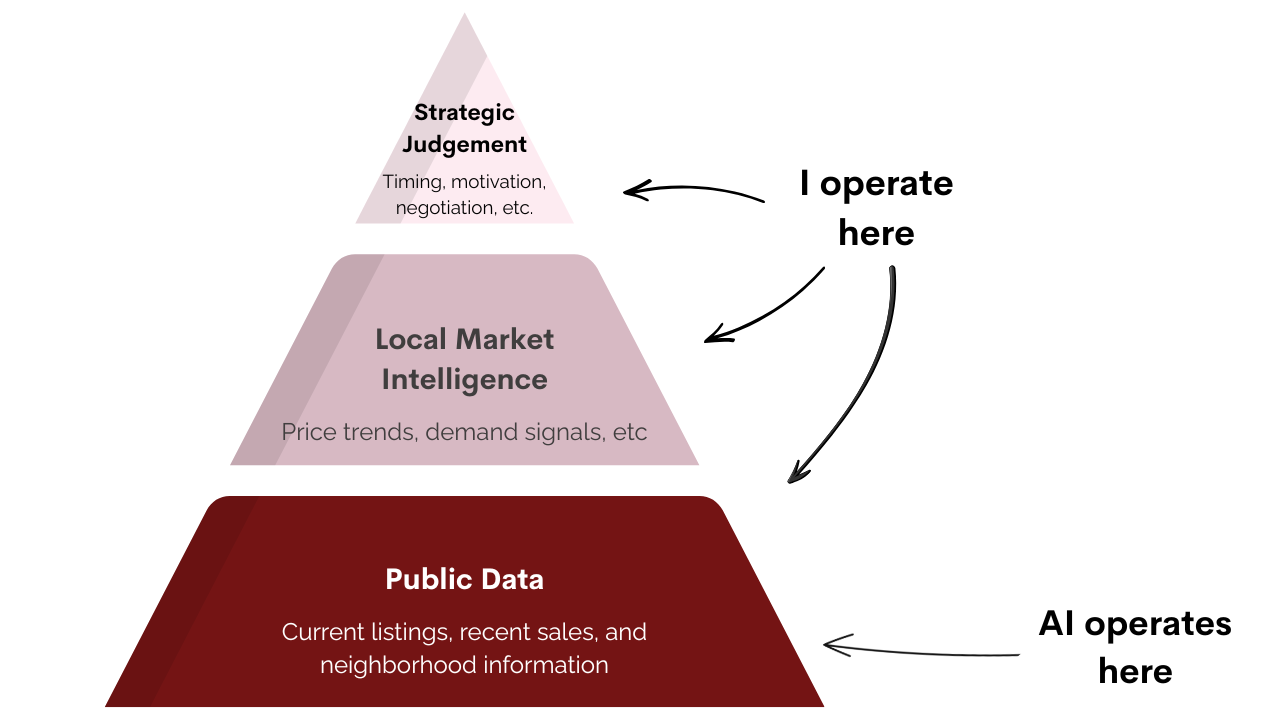
I think of it as three layers, stacked like a pyramid.
At the base, you've got public data: current listings, recent sales, basic neighborhood info. This is where AI lives. It's genuinely useful here, and there's nothing wrong with using it to get oriented.
The middle layer is local market intelligence: actual price trends, demand signals, what's happening street by street in places like Oak Forest or Garden Oaks versus the citywide averages you'll find in a generic search. This takes someone who's actually working those neighborhoods day to day.
The top of the pyramid is strategic judgment: timing, motivation, negotiation. This is where a transaction actually gets won or lost, and it's the layer no AI tool can see into. It doesn't know your buyer's pre-approval is about to expire, or that the seller across the table is more anxious to close than they're letting on. That's not data. That's experience.
What this means if you're selling
Use AI to get curious. Use it to ask "what is a 1031 exchange" or "what's a typical timeline for closing in Texas." Don't use it to price your home, interpret an inspection report, or decide how to respond to a low offer. Those moments call for someone who knows your specific market and has sat across the table from enough buyers and sellers to know how this particular negotiation is likely to go.
Even with how fast AI adoption has grown, most people still say they trust a real estate agent to verify what they're reading, and that tracks with what I see in my own conversations with clients. AI is a helpful assistant. It is not the final authority. And if you're using it to get a second opinion on your own sale, just remember: it's probably telling the other side something completely different.
If you're thinking about selling and want an actual second opinion, not an AI-generated one, I'm always happy to talk through your specific situation.


 Erase note
 You currently have no custom folders