Sign In
Create an account and enjoy all the benefits of HAR.com!
Sign In
Sign in using social account


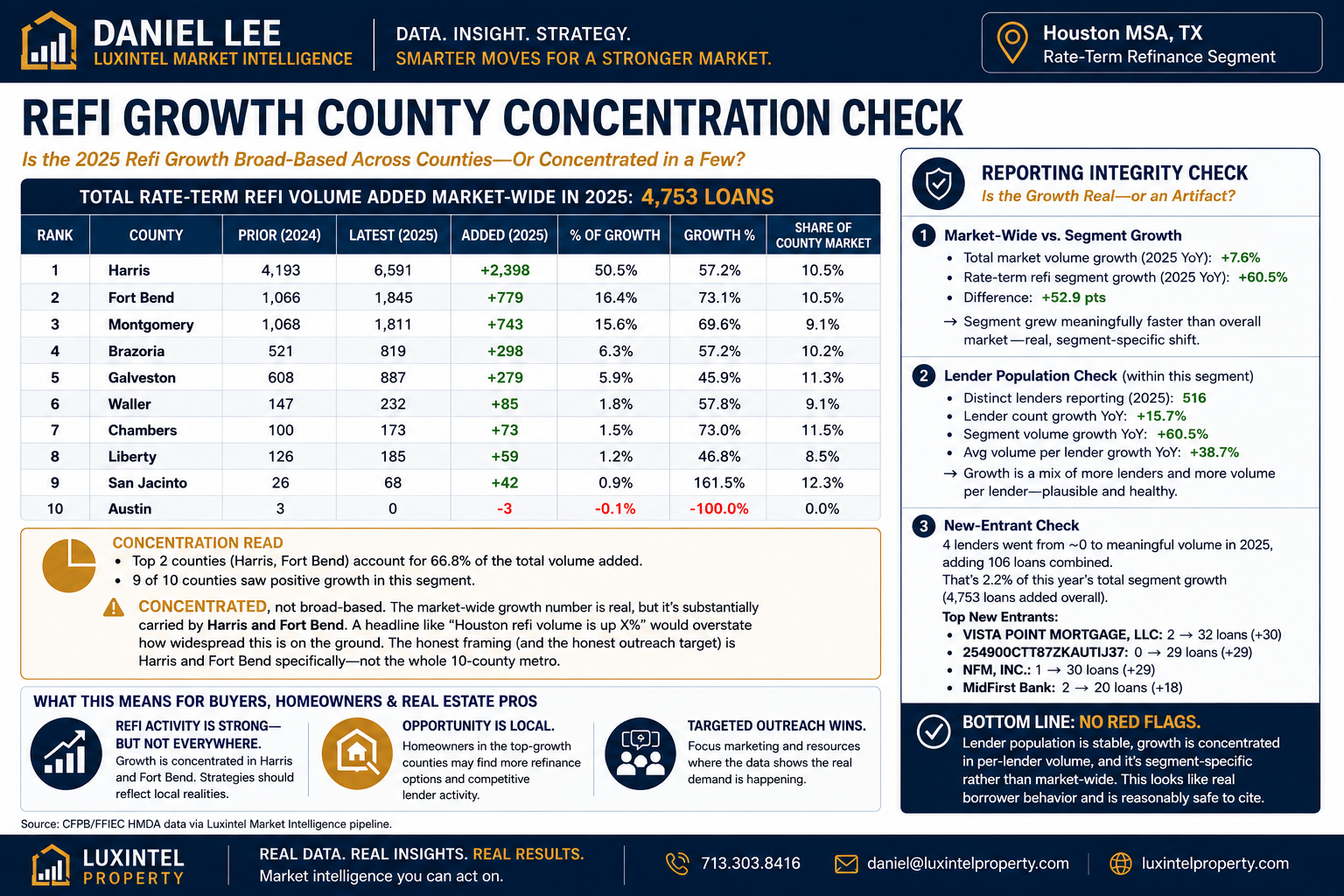
If you've assumed refinancing only makes sense when rates drop, 2025 in Houston is worth a second look.
According to federal Home Mortgage Disclosure Act (HMDA) data covering all ten counties in the Greater Houston metro, rate-and-term refinances — the kind where a homeowner replaces their existing mortgage to get a better rate or term, without pulling out cash — rose 60.5 percent year-over-year in 2025. For context, total mortgage activity across the metro grew just 7.6 percent over the same period. Refinancing didn't just grow with the market. It grew nearly eight times faster.
The surprising part: the math doesn't obviously support it
Normally, a rate-and-term refinance only makes financial sense if today's rate is meaningfully below the rate a homeowner already has. Looking at the average rate homeowners locked in during each year since 2018, that's not clearly the case here. Buyers from 2020 and 2021, when rates sat near 3 percent, have no incentive to refinance into 2025's average rate of roughly 6.5 percent. Even homeowners from 2023 and 2024 — the highest-rate years in this dataset — were only paying rates about a quarter of a point above today's average, well under what most homeowners need to see to make refinancing worth the closing costs.
That's what makes this trend genuinely interesting rather than a headline that writes itself. The growth isn't concentrated among government-backed loans, where lighter underwriting can make refinancing worthwhile even without a big rate gap — FHA, VA, and USDA loans held roughly the same share of refinance activity in 2025 as they did the year before. And it isn't a data artifact, either. The lenders reporting this activity are largely the same lenders who were active in 2024, and per-lender refinance volume rose sharply across the board rather than being driven by a handful of new entrants.
It's a metro-wide pattern, not a pocket
Nine of Houston's ten counties saw rate-and-term refinance growth in 2025, and eight of them landed in a tight band between 46 and 74 percent — Fort Bend, Chambers, Montgomery, Waller, Brazoria, Harris, Liberty, and Galveston all moved together. That kind of consistency across a metro this large points to something structural in the local market rather than one submarket or one large lender skewing the numbers.
Cash-out refinancing and home equity lines are rising too
Rate-and-term refinancing isn't the only story. Cash-out refinances rose 22.3 percent year-over-year and now make up nearly 10 percent of all mortgage activity in the metro. Home equity lines of credit (HELOCs) grew 8.3 percent. Unlike rate-and-term refinancing, these products aren't about chasing a lower rate — they're about homeowners tapping equity they've built, whether for renovations, debt consolidation, or other uses.
One important caveat if you're considering a HELOC specifically: denial rates on HELOCs in this data run notably higher than other loan types — over half of applications were denied in 2025, compared to roughly 20 percent for purchase loans. That doesn't mean HELOCs aren't worth pursuing. It means getting a clear picture of your qualification before applying matters more for this product than almost any other.
What this means if you're a homeowner
The takeaway isn't "rates dropped, so refinance now." They haven't, meaningfully. The takeaway is that a large number of your neighbors are refinancing anyway, for reasons the simple rate math doesn't fully capture — likely a mix of individual financial circumstances, loan restructuring, and local factors specific to this market. Whether refinancing makes sense for your situation depends on your current rate, your goals, and your loan type, not just where the national rate sits today.
If you're weighing whether a refinance — rate-and-term, cash-out, or a HELOC — actually pencils out for your specific mortgage, that's exactly the kind of question a data-driven conversation can answer quickly. As both a licensed real estate agent and a licensed mortgage loan originator, I look at both sides of that equation together: what your home is worth today, what your current loan looks like, and what refinancing would actually change for you. If you'd like that conversation, reach out any time.
Daniel Lee — Licensed Real Estate Agent, TREC #838122 Licensed Mortgage Loan Originator, NMLS #2714789. Data source: CFPB/FFIEC Home Mortgage Disclosure Act (HMDA), 2018–2025, Greater Houston MSA.


 Erase note
 You currently have no custom folders