Sign In
Create an account and enjoy all the benefits of HAR.com!
Sign In
Sign in using social account


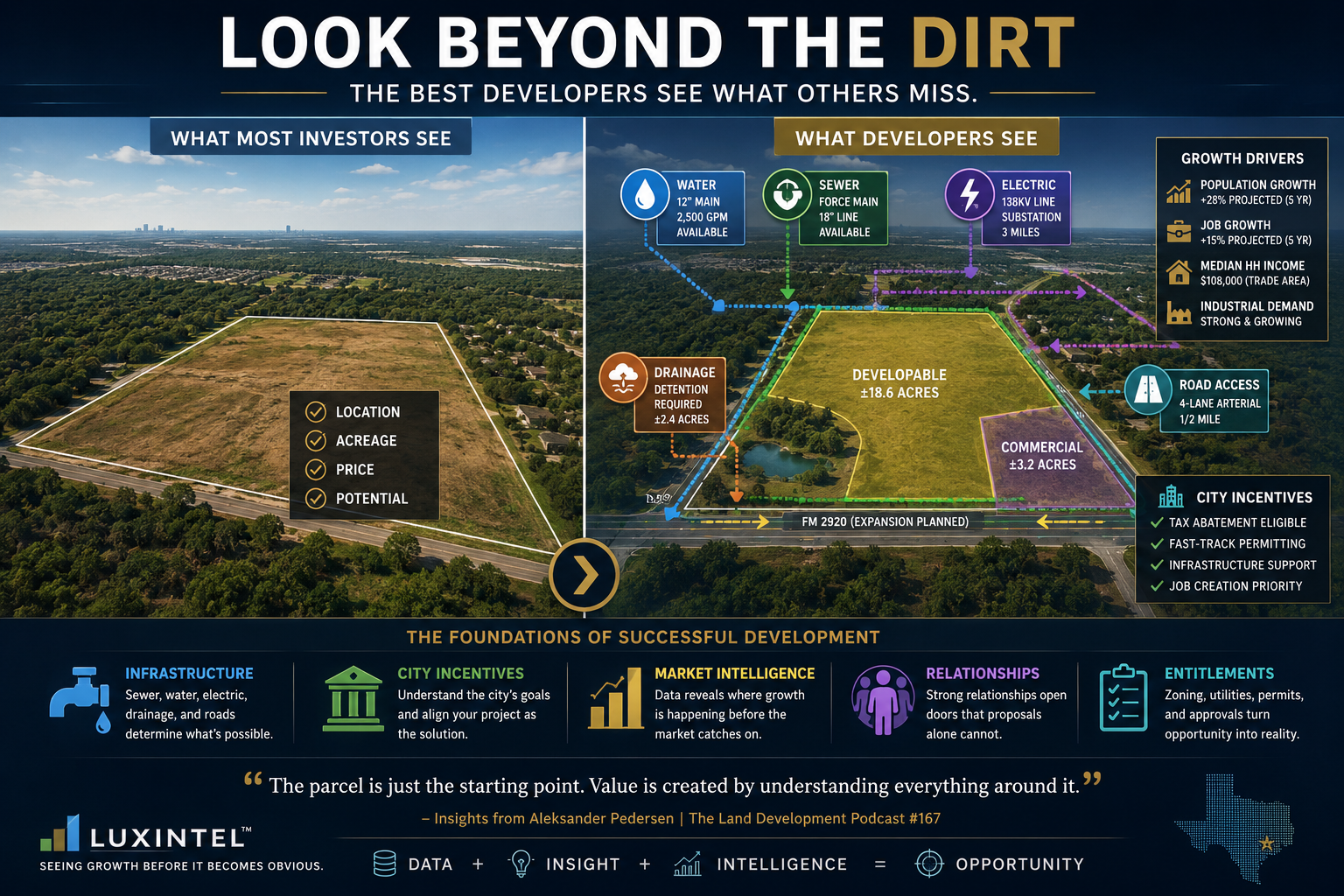
What does a developer who trained in Norway and Italy have to teach Texas real estate professionals?
Quite a lot, it turns out.
Aleksander Pedersen recently joined Ryan Glick on The Land Development Podcast (Episode 167) to discuss his journey from Scandinavian development projects to leading industrial land development in Texas. The conversation surfaced lessons that apply directly to anyone buying, selling, or developing real estate in Houston, the surrounding suburbs, or anywhere across the Lone Star State.
As someone who analyzes Texas and Louisiana real estate markets daily through the Luxintel platform, I found the conversation validated several things I see in the data -- and challenged a few assumptions that even experienced professionals hold.
Here is what stood out most.
The First Question Most Investors Get Wrong
When most buyers evaluate a property, they start with location, price, and acreage. Those factors matter. But experienced developers typically begin somewhere else entirely.
They ask about infrastructure.
Is sewer available? Is water capacity sufficient? Can the electric grid support the intended use? What do drainage requirements look like? Can the road network actually support the density or intensity of the proposed project?
A 20-acre parcel might look like a home run on paper. Without infrastructure access, it can easily become a multi-year entitlement exercise that consumes capital and produces nothing. Meanwhile, a smaller, less visually impressive parcel positioned near existing utility capacity can generate substantially more value in a fraction of the time.
Infrastructure is not a checkbox item. It is often the single most important factor in whether a development project succeeds or stalls.
Cities Are Not Just Gatekeepers. They Are Partners.
One of the most valuable shifts in perspective Pedersen described is how the best developers approach municipalities.
Most developers think about city hall as the place where they go to get approvals. The most successful developers think about city hall as the place where they go to solve problems -- the city's problems.
Every municipality has goals. Some are chasing industrial investment and job creation. Others are focused on housing supply. Some want downtown revitalization. Others are trying to fully utilize infrastructure capacity they have already built.
Developers who understand what a specific city is actually trying to accomplish can position their projects as solutions rather than requests. That distinction changes everything -- from how quickly meetings get scheduled to how favorably applications get reviewed.
This is not about gaming the system. It is about speaking a language that city planners, economic development directors, and elected officials actually use.
Why Texas Keeps Winning
Pedersen's dual experience in Scandinavia and Texas offers a useful contrast that helps explain why markets like Houston, Dallas-Fort Worth, San Antonio, and Austin continue attracting massive capital flows.
European development models -- particularly in Norway -- tend to emphasize extensive public engagement, detailed regulatory oversight, and long-range coordinated planning. These systems often produce well-organized urban environments. They also produce lengthy timelines, and in many cases, structural limits on what private developers can actually accomplish.
Texas operates on a fundamentally different philosophy. Strong private property rights, a relatively streamlined entitlement environment, and a broadly pro-growth culture have created conditions where development capital moves faster and more freely than in most comparable markets.
That does not mean Texas development is easy or without complexity. Anyone who has navigated a municipal utility district formation, a variance hearing, or a large-scale industrial entitlement in the Houston metro knows better. But the underlying orientation of the regulatory environment -- toward enabling rather than restricting private development -- is a genuine competitive advantage for this market.
That advantage is reflected in population data, job growth numbers, and continued inbound migration that Luxintel tracks month over month.
Data Opens the Door. Relationships Close the Deal.
As a statistician who built Luxintel around the power of market data, I have a natural appreciation for analytics. Good data -- drawn from MLS activity, demographic trends, mortgage patterns, infrastructure investment, and economic indicators -- can identify emerging corridors long before they become widely recognized.
But Pedersen's experience reinforced something the data alone cannot capture.
Development is still fundamentally a relationship business.
Relationships with city planners, engineers, utility providers, economic development officials, surveyors, contractors, and local stakeholders frequently determine whether an opportunity becomes a project or stays permanently on the whiteboard. Data can identify where value is likely to emerge. Relationships determine whether you can actually execute.
The developers who consistently outperform are the ones who have built networks as carefully as they have built analytical capabilities. Neither alone is enough.
The Questions That Separate Good Developers from Great Ones
The most forward-looking developers have stopped asking only "what is this land worth today?" They are asking a different set of questions:
What infrastructure investments are planned in this corridor over the next five years? What population trends are driving demand in this submarket? Which industries are expanding in this region and where do they want to be? What incentives is this municipality actively trying to deploy? What does this city want to look like in ten years -- and how does this project serve that vision?
These questions transform development from speculation into strategy. They also create a durable information advantage in markets where most participants are still reacting to what has already happened rather than positioning for what comes next.
At Luxintel, this is exactly the kind of forward intelligence we work to deliver -- integrating infrastructure data, demographic movement, economic indicators, and local market activity to help clients see what is coming before it becomes obvious.
The Bottom Line
Aleksander Pedersen's path from Scandinavian design studios to Texas industrial development is an unusual one. But the principles he has assembled along the way are universally applicable.
Real estate development is not fundamentally about land. It is about understanding the systems that determine what land can become -- infrastructure systems, economic systems, regulatory systems, community systems, and relationship systems.
The parcel is just the starting point. Everything that creates value from that point forward is about how well a developer understands and navigates the world surrounding it.
For buyers, sellers, investors, and developers working in the Houston metro and across Texas, that is the most important lesson Pedersen's story has to offer.
Look beyond the dirt.
To listen to the full episode with Aleksander Pedersen, visit The Land Development Podcast, Episode 167, on Apple Podcasts, Spotify, or YouTube.
Daniel Lee, MS, is the founder of Luxintel, a real estate market intelligence platform serving Texas and Louisiana. Luxintel integrates MLS data, demographic trends, infrastructure investment, and economic indicators to identify emerging growth corridors ahead of the broader market.


 Erase note
 You currently have no custom folders