Sign In
Create an account and enjoy all the benefits of HAR.com!
Sign In
Sign in using social account


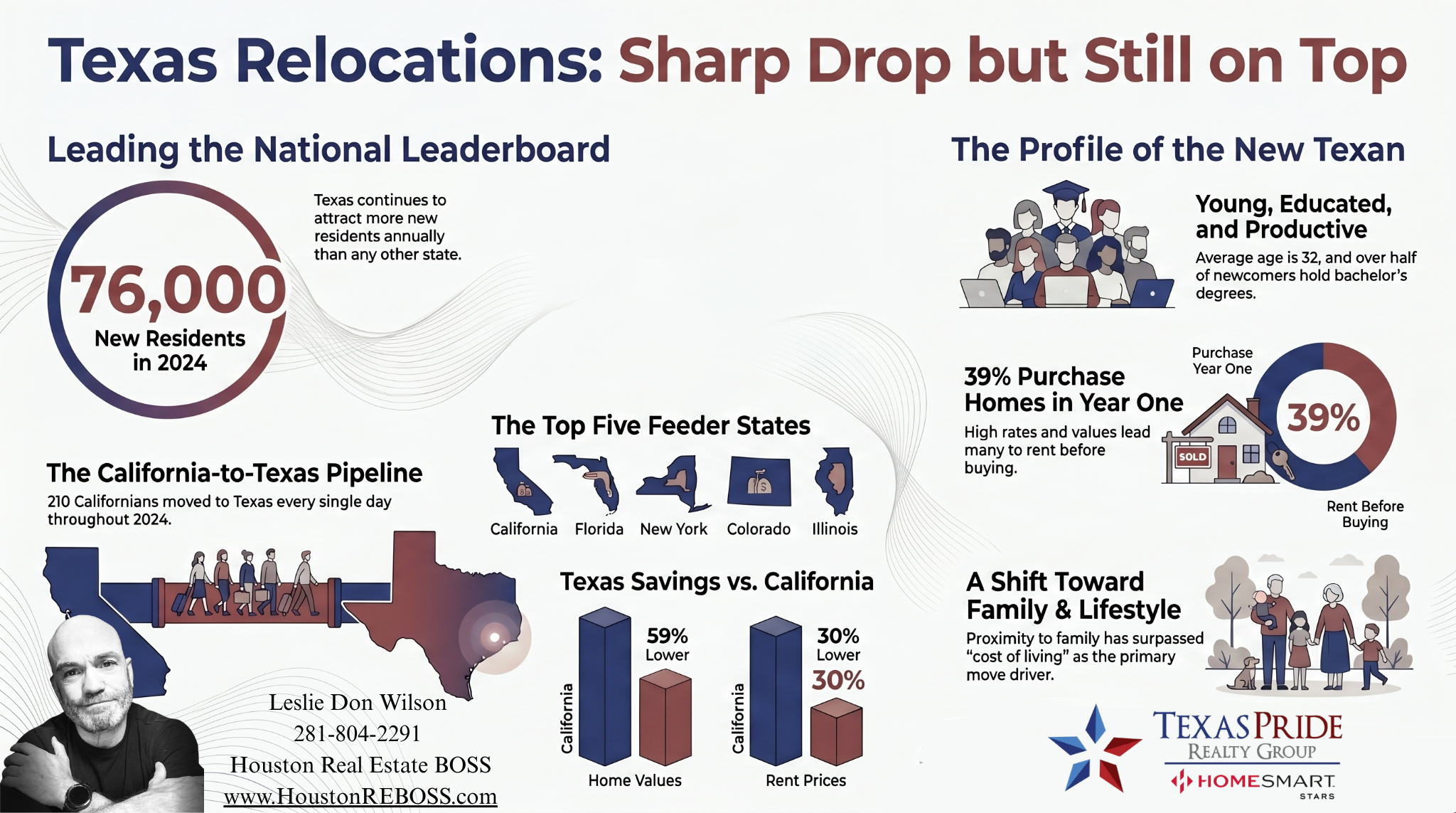
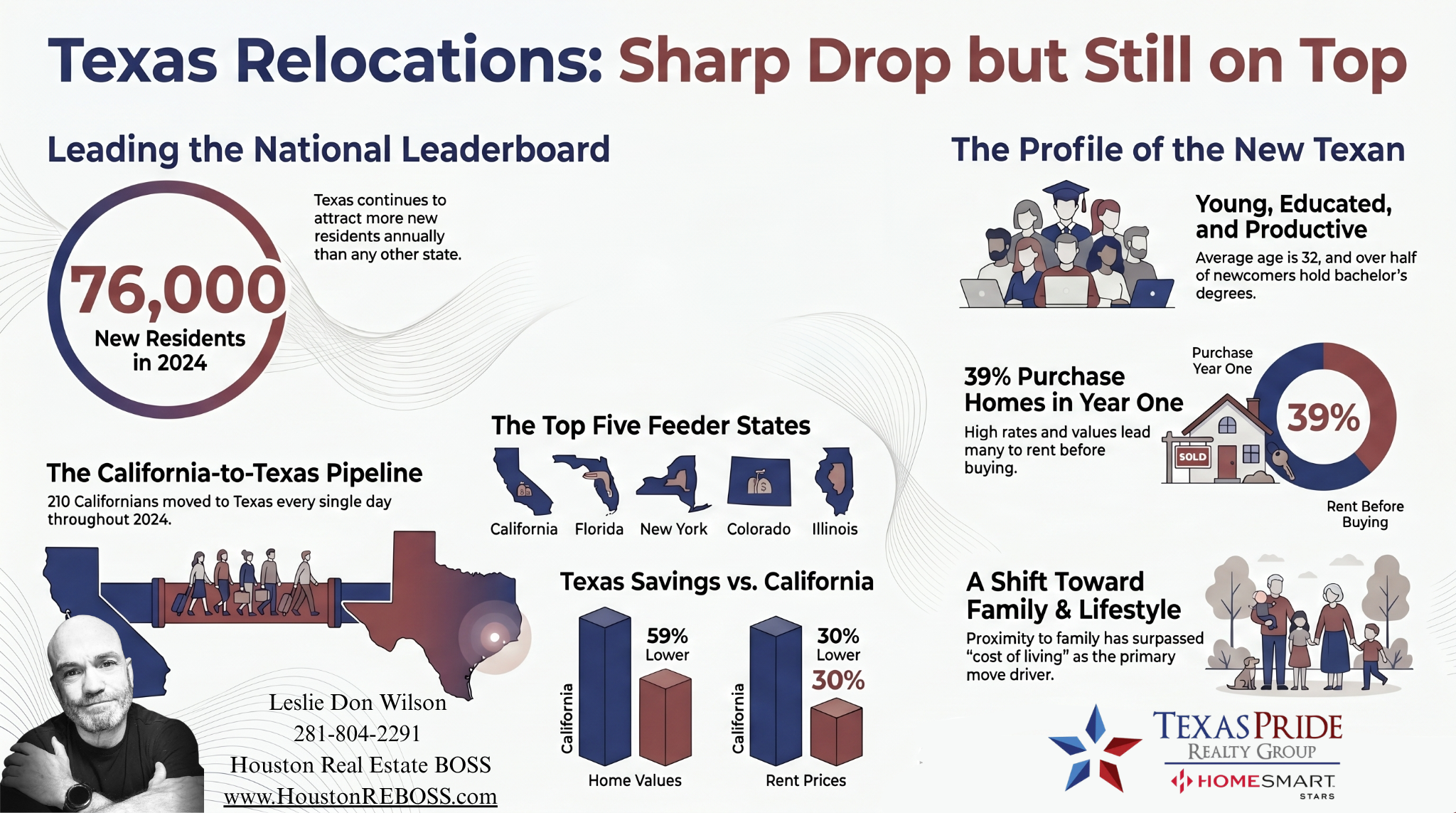
America's pandemic-era relocation boom has cooled considerably. Interstate migration fell to its lowest level in a decade in 2024, with just 7.15 million Americans moving across state lines — more than a million fewer than at its 2022 peak.
But even as interstate moving slows nationally, Texas continues to hold its place as the top destination for domestic migration, attracting more new residents annually than any other state. A new report from Storage Cafe confirms what real estate professionals across the state already see on the ground: people are still choosing Texas.
California continues to be the largest source of new Texans, with the California-to-Texas pathway still ranking as the biggest state-to-state migration route in the country. About 210 Californians made that move every single day in 2024, drawn by home values running roughly 59% lower and rents about 30% below what they left behind. Florida is right behind with roughly 52,000 people making the Texas trek. Significant numbers also arrived from New York, Colorado, and Illinois — combining for approximately 205,500 arrivals, or about 38% of all Texas move-ins.
New arrivals are spreading across the state, from the metros to the suburbs to the piney woods. Explore homes and market data by region below.
Texas ranks first for net domestic migration. The continued draw from high-cost coastal markets and other large Sunbelt states reflects a mix of affordability-driven and job-driven relocation. Affordability, long a major Texas lure, is not the attraction it once was. Home prices have risen about 124% over the past decade, and major metro areas like Austin, Dallas-Fort Worth, and Houston have all seen steep price hikes. While Texas continues to rank as significantly more affordable than California, the once-vast price gap has narrowed. But many who left the West Coast still consider Texas a bargain.
Only about 39% of new arrivals purchase a home within their first year after relocating. Higher mortgage rates and rising home values are prompting many to rent first, wait out market conditions, or reassess long-term plans before committing. More than half of new arrivals hold a bachelor's degree or higher, and the average age of those moving into the state is just 32. Millennials made up 32% of Texas's domestic gain, Gen X'ers 24%, and Gen Z'ers 14% — roughly seven in ten net newcomers from these three groups, indicating a sustained influx of productive, career-oriented people.
The enticements that once tempted households to cross state lines — cheaper housing, lower taxes, and more space — have weakened. Many Sunbelt states have seen home prices climb sharply, eroding their affordability advantage. Elevated mortgage rates are also locking many homeowners in place. Millions secured ultra-low rates several years ago and are now reluctant to trade them for loans that would significantly raise their monthly payments.
Work is also reshaping mobility patterns. As more employers scale back fully remote work arrangements, relocating to a lower-cost state carries new professional risks. According to United Van Lines' latest movers study, "new job or company transfer" accounted for just 25.9% of moves in 2025, down from 29.1% in 2023 and dramatically below the 2018 peak of 47.6%.
Instead, migration today is increasingly anchored in personal relationships. Strengthening family ties became the most common reason for interstate relocation in both 2024 and 2025, with 29.1% of relocators citing proximity to family as the primary driver. Retirement remains another steady motivation at 13.9%, while lifestyle changes account for 9.5% of moves. Notably, "improved cost of living" represents just 3.2% of moves in 2025.
"Essentially, we're seeing a more cautious, more constrained America. Moving across state lines is no longer an obvious path to saving money. Instead, relocation decisions are increasingly shaped by pragmatic and lifestyle-oriented considerations — strengthening family ties, planning retirement or seeking stability amid economic uncertainty and climate pressures." — Storage Cafe
Texas remains the destination of choice across all of those motivations. Whether a buyer is looking for a DFW suburb with top-rated schools, a vibrant Austin-area community, an inner-loop Houston neighborhood, or the peaceful pace of East Texas, the Lone Star State still has more room — and more reasons to stay — than just about anywhere else in the country.




 Erase note
 You currently have no custom folders