Sign In
Create an account and enjoy all the benefits of HAR.com!
Sign In
Sign in using social account


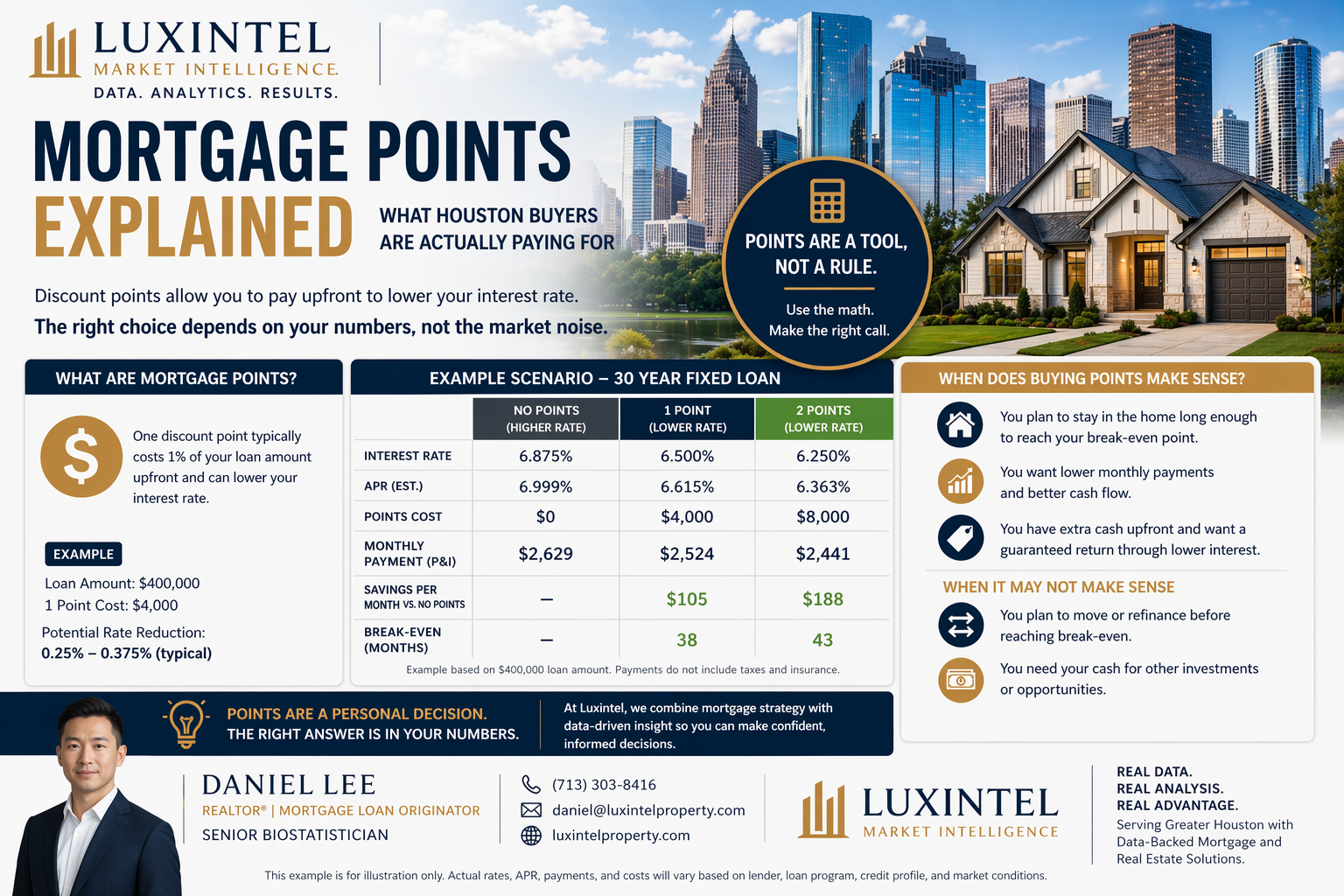
When a lender hands you a loan estimate and mentions "points," the conversation often moves too fast. You are signing documents, juggling closing costs, and trying to remember which box needs your initials. But the decision to buy mortgage points -- or not -- is one of the most consequential financial choices in your entire transaction, and most buyers make it without a clear framework.
This post gives you that framework.
What a Mortgage Point Actually Is
A mortgage discount point is a prepaid interest payment. One point equals one percent of your loan amount. On a $400,000 loan, one point costs $4,000 paid at closing. In exchange, your lender reduces your interest rate -- typically by 0.20 to 0.25 percentage points per point purchased, though this varies by lender and market conditions.
The logic is straightforward: you pay more upfront to pay less every month for the life of the loan.
What makes points complicated is that the benefit only materializes if you stay in the loan long enough to recover what you paid. That recovery threshold has a name: the break-even point.
The Break-Even Calculation
Here is the math in plain terms.
Suppose you are borrowing $400,000 at 7.00 percent on a 30-year fixed mortgage. Your principal and interest payment is approximately $2,661 per month.
Your lender offers you the option to buy the rate down to 6.75 percent for one point, which costs $4,000.
At 6.75 percent, your monthly payment drops to approximately $2,594 -- a savings of $67 per month.
To find your break-even point, divide the cost of the point by your monthly savings:
$4,000 divided by $67 equals approximately 60 months, or five years.
If you stay in this loan for at least five years, buying the point was the right financial decision. Every month beyond that, you come out further ahead. If you sell, refinance, or pay off the loan before five years, you lost money on the trade.
When Buying Points Makes Sense
Buying points tends to make sense when three conditions are present.
First, you have a long time horizon. If you are purchasing a forever home or a long-term primary residence, a break-even period of four to six years is very manageable. The math works strongly in your favor over a 10- or 15-year hold.
Second, you have the cash to spare. Points only help you if paying them does not strain your reserves. Depleting your emergency fund or your post-closing liquidity to buy a lower rate is a poor trade. The monthly savings rarely justify financial vulnerability in the early months of homeownership.
Third, you do not expect to refinance soon. In a market where many buyers are betting on rate decreases and planning to refinance within two or three years, paying points at today's rate may mean you never reach break-even before the loan changes.
When Buying Points Does Not Make Sense
Points are a poor use of cash in several common situations.
If you are stretching to afford the down payment and closing costs, that $4,000 or $8,000 is better left in your account. A small monthly savings does not offset the risk of being cash-thin in a new home.
If you are relocating for a job, buying in a transitional life stage, or purchasing a starter home with a realistic expectation of moving within five years, the break-even timeline works against you before it works for you.
If current rates are elevated and you believe a refinance is likely within 24 to 36 months, you are essentially prepaying interest on a loan you plan to replace. The lender benefits from this arrangement. You do not.
A Note on Lender-Paid Points
Some loan structures involve the lender paying your closing costs in exchange for a higher interest rate. This is the inverse of buying points -- you accept a worse rate to reduce your upfront cash requirement. It follows the same break-even logic in reverse. If you stay in the loan a long time, you overpay in interest. If you move or refinance quickly, you come out ahead.
Neither structure is inherently good or bad. Both require you to honestly assess how long you will hold the loan.
What Houston Buyers Should Know Right Now
In the Greater Houston market, where median days on market and list-to-sale price ratios have been shifting across submarkets, buyers are increasingly using point purchases as a negotiation tool. Some sellers are offering seller-paid closing costs or rate buydowns as concessions, particularly in price segments with elevated inventory. This means the cost of buying your rate down may not always come from your own pocket -- it is worth asking your agent whether a temporary or permanent rate buydown is a viable term in your offer.
A temporary buydown, such as a 2-1 buydown structure, reduces your rate for the first two years before stepping up to the note rate. These have become more common in new construction transactions and can meaningfully reduce your payment during the adjustment period after purchase. They operate on different math than permanent points, but the same underlying question applies: does the cost justify the benefit given your specific timeline?
The Bottom Line
Mortgage points are not a trick or a gimmick. They are a legitimate financial instrument with a clear break-even structure. Whether they benefit you depends entirely on how long you hold the loan, how much cash you have available, and what you believe about your future financing options.
Before your next loan estimate conversation, ask your lender two questions: what is the cost per point, and how many months until I break even? If you have a clear answer to both, you can make this decision like the financial choice it actually is -- not a line item you sign through at closing.




 Erase note
 You currently have no custom folders