Sign In
Create an account and enjoy all the benefits of HAR.com!
Sign In
Sign in using social account


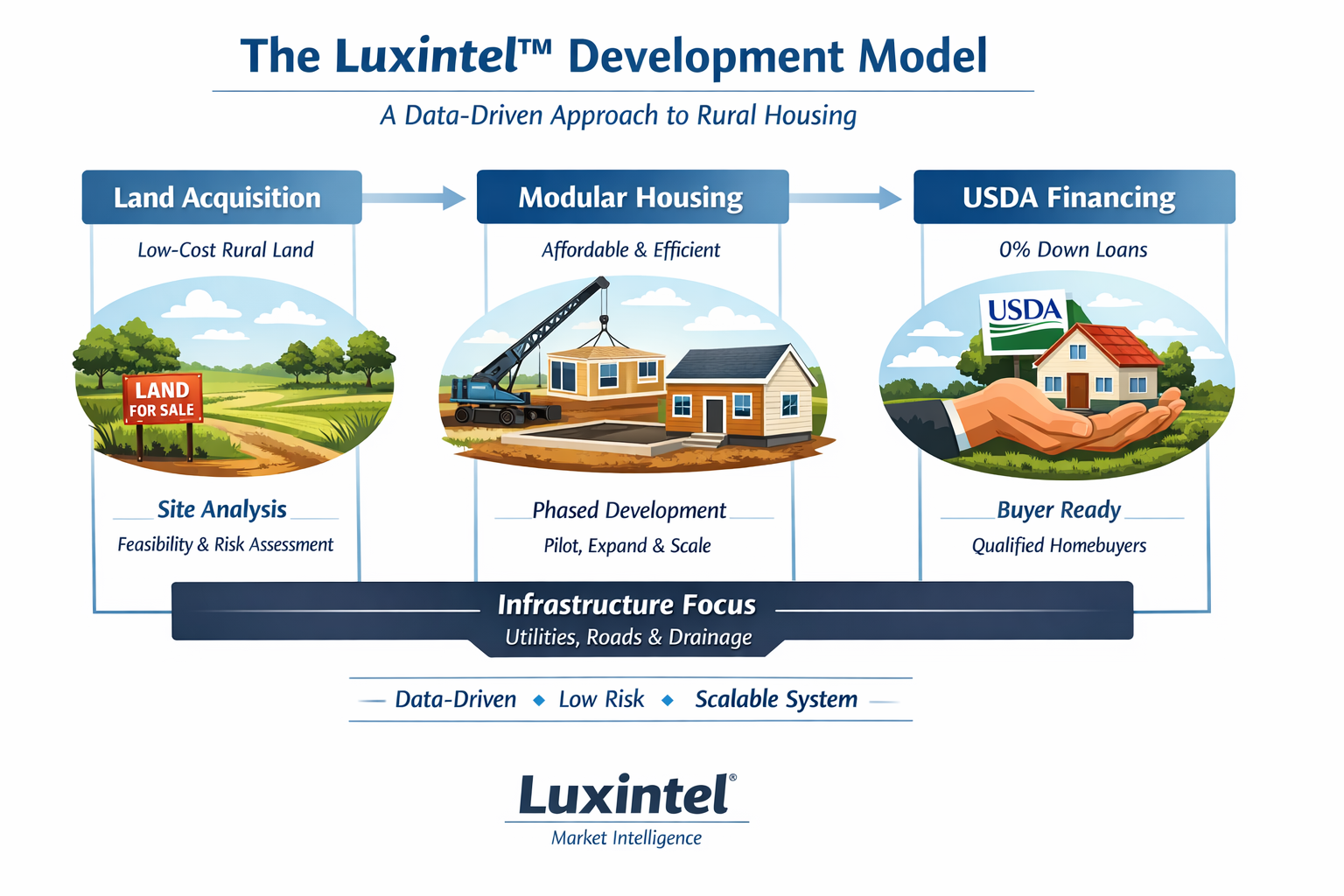
The traditional approach to land investing often centers around one assumption: buy land cheap and figure out the rest later. However, real-world development tells a very different story. The success of a project is rarely determined by land price alone. Instead, it is driven by infrastructure feasibility, regulatory alignment, and access to financing.
At Luxintel, we approach development through a fundamentally different lens. Our model is not about flipping land. It is about building a repeatable system that converts rural land into sustainable, financeable housing communities.
Across many rural and semi-rural markets, there is strong demand for homeownership. However, three major barriers consistently prevent that demand from being realized:
The Luxintel model is designed to solve all three simultaneously.
The foundation of our strategy is simple but powerful:
Acquire low-cost rural land, validate feasibility through engineering and environmental analysis, deploy modular housing, and exit through USDA-backed financing.
This creates a closed-loop system where:
This approach transforms development into a data-driven process rather than a speculative gamble .
One of the most important insights in development is this:
Cheap land can become expensive very quickly.
Infrastructure costs such as sewer systems, road construction, and drainage can easily exceed the purchase price of the land itself. In many cases, these costs determine whether a project succeeds or fails.
At Luxintel, we treat infrastructure as the true economic engine of the deal. Every property is evaluated based on:
This ensures that we are not just buying land, but acquiring a viable development opportunity.
To maintain affordability and scalability, we focus on modular and manufactured homes. These homes offer:
Typical unit economics range from approximately $170,000 to $210,000 all-in, with potential sale prices between $220,000 and $260,000 depending on the market .
A key distinction in our model is how we use USDA financing.
USDA is not used to acquire land or fund development. Instead, it is used to empower the end buyer. By offering 0% down financing in eligible rural areas, USDA dramatically expands the pool of qualified buyers.
This increases demand, improves absorption speed, and reduces risk for investors.
In simple terms: USDA is the demand engine, not the capital source.
Rather than developing an entire subdivision at once, Luxintel uses a phased approach:
Luxintel is not focused on a single deal. It is designed as a scalable platform.
By combining data analysis, structured feasibility, modular construction, and financing alignment, we are building a system that can be replicated across multiple markets.
The long-term vision is to identify and solve inefficiencies in housing development at scale, creating opportunities for investors while expanding access to affordable homeownership.
Rural development is not simple. It requires discipline, planning, and the ability to manage uncertainty.
But when approached correctly, it represents one of the most overlooked opportunities in real estate today.
At Luxintel, we are not just developing land. We are building a system.




 Erase note
 You currently have no custom folders