Sign In
Create an account and enjoy all the benefits of HAR.com!
Sign In
Sign in using social account


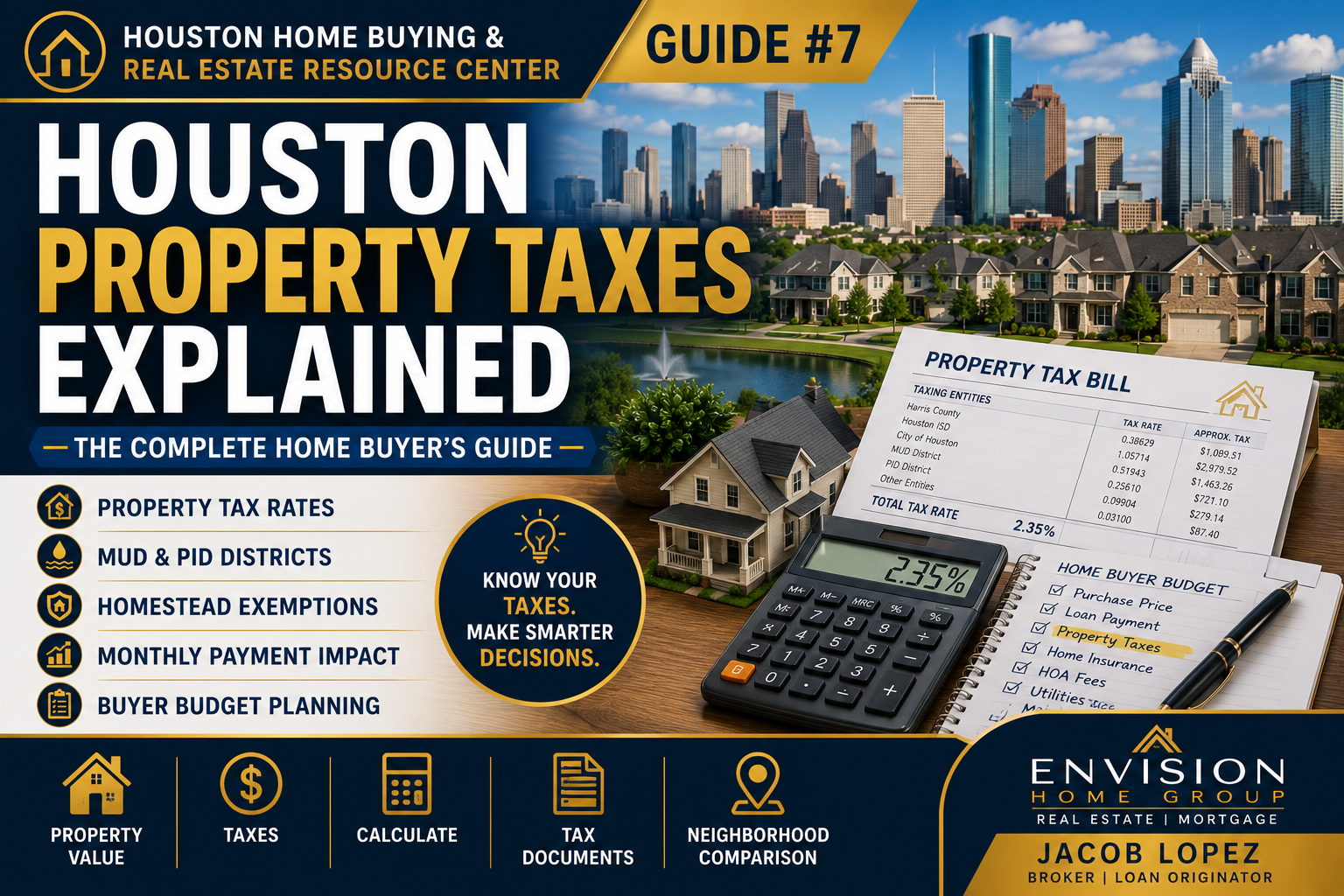
When buyers start looking at homes, they usually focus on one number:
The purchase price.
But after helping buyers throughout the Houston area, I've learned that another number often has an even bigger impact on affordability:
Property taxes.
Two homes with nearly identical purchase prices can have dramatically different monthly payments simply because they're located in different taxing districts.
That's why understanding property taxes before writing an offer is one of the smartest things you can do.
In this guide, I'll explain how property taxes work in Texas, what influences your tax bill, and how to compare homes more accurately so you can make informed financial decisions.
Property taxes in Texas are based primarily on:
The taxable value of the property
The tax rates established by local taxing entities
Whether the property is located within special taxing districts such as a Municipal Utility District (MUD) or Public Improvement District (PID)
Any exemptions you qualify for, such as a homestead exemption
Property taxes are typically included as part of your monthly mortgage payment if you escrow taxes through your lender.
Understanding these costs before buying helps you evaluate the true monthly cost of owning a home.
One of the first questions many relocation buyers ask is:
"Why are property taxes so much higher in Texas?"
Texas does not have a state income tax.
Instead, local governments rely more heavily on property taxes to help fund services such as:
Public schools
Roads and infrastructure
Police and fire protection
Parks and recreation
Libraries
County and municipal services
While tax rates may appear higher than in some other states, it's important to consider the broader tax structure rather than looking at property taxes in isolation.
One of the biggest misconceptions I encounter is that buyers should automatically avoid neighborhoods with higher tax rates.
In reality, it's not that simple.
Some newer master-planned communities have higher tax rates because they're still paying for infrastructure improvements such as roads, utilities, drainage systems, and community amenities.
In return, buyers may enjoy newer schools, resort-style pools, parks, walking trails, fitness centers, and beautifully maintained common areas.
Other buyers may prioritize lower tax rates in more established neighborhoods.
Neither choice is inherently better.
The right decision depends on your budget, lifestyle, and long-term goals.
Several factors influence the amount you'll pay each year:
Local appraisal districts estimate your home's taxable value.
This value may change over time based on market conditions and state regulations.
Your total tax rate is made up of several taxing authorities, including:
School district
County
City (where applicable)
Special districts
These rates vary by location.
Qualifying for certain exemptions can reduce your taxable value and potentially lower your property tax bill.
One of the questions I hear most often from buyers looking at new construction is:
"What is a MUD?"
A Municipal Utility District (MUD) is a special-purpose district that helps finance infrastructure for developing communities.
This may include:
Water systems
Sewer systems
Roads
Drainage
Utilities
Homes located within a MUD may have higher tax rates while the infrastructure is being paid for.
However, these communities often provide attractive amenities and modern infrastructure that many buyers appreciate.
A Public Improvement District (PID) is another type of special taxing district.
Instead of financing utilities, PIDs often help fund improvements such as:
Landscaping
Parks
Entry monuments
Roads
Public spaces
Not every community has a PID, but it's important to understand whether one applies before purchasing a home.
If the home becomes your primary residence, you may qualify for a Texas homestead exemption.
Potential benefits include:
Lower taxable value
Tax savings
Certain limitations on annual increases in taxable value for qualifying properties
Eligibility requirements and benefits are determined by Texas law and local appraisal districts.
One of the biggest advantages of preparing financing early is understanding how taxes affect affordability.
For example:
A home with a slightly higher purchase price but lower tax rate may actually have a similar or even lower monthly payment than a less expensive home with a significantly higher tax rate.
That's why I encourage buyers to compare total monthly payments rather than focusing only on the listing price.
Before purchasing a home, consider:
What is the current property tax rate?
Is the community located within a MUD or PID?
Will I qualify for a homestead exemption?
How much of my monthly payment is property taxes?
Are there HOA dues in addition to taxes?
How do taxes compare to nearby communities?
Not necessarily.
Many communities with higher tax rates also offer newer infrastructure, excellent amenities, and strong long-term growth potential.
Every neighborhood is different.
Even communities located only a few miles apart can have noticeably different tax rates.
Your monthly payment depends on much more than the sales price.
Taxes, insurance, HOA dues, and financing all play important roles.
When comparing homes, ask your lender or real estate professional to prepare side-by-side monthly payment estimates.
I've helped buyers compare homes where the purchase prices were nearly identical, yet one property's monthly payment was several hundred dollars higher because of differences in property taxes and insurance.
Looking beyond the listing price almost always leads to better long-term decisions.
In many cases, yes. If your loan includes an escrow account, your lender typically collects a portion of your estimated annual property taxes with each monthly payment.
Yes. Taxable values, tax rates, exemptions, and other factors may change over time.
Not necessarily. Many buyers find that the benefits of newer infrastructure and community amenities outweigh the additional tax costs. It depends on your priorities and budget.
Your lender and real estate professional can help you estimate taxes using current tax rates and available public information. Remember that estimates can change based on future appraisals and applicable exemptions.
Completed Guides
? Guide #1 — Best Houston Suburbs for First-Time Home Buyers
? Guide #2 — Should You Buy New Construction?
? Guide #3 — Best Areas Near Houston for Families Under $400K
? Guide #4 — How Seller Concessions Work in Texas
? Guide #5 — Hidden Costs of Buying a Home in Texas
? Guide #6 — What to Know Before Hiring a Real Estate Broker
Next Recommended Guides
→ Guide #8 — FHA vs. Conventional Loans in Texas
→ Guide #9 — How Much House Can I Afford?
→ Guide #10 — The Complete Houston Relocation Guide
Each guide builds upon the last, helping you make informed, confident decisions throughout your home-buying journey.
Buying a home isn't just about finding the right neighborhood it's about understanding the full financial picture.
If you're comparing homes in the Greater Houston area, I'd be happy to help you estimate monthly payments, explain how taxes impact affordability, compare communities, and build a personalized buying strategy before you make an offer.
A Buyer Strategy Session is designed to help you understand your options so you can move forward with confidence.
Jacob Lopez is a Houston real estate broker and mortgage loan originator who helps buyers and sellers throughout the Greater Houston area make informed real estate decisions through education, transparency, and personalized guidance.
The Houston Home Buying & Real Estate Resource Center is an educational library designed to answer the most common questions about buying, selling, and investing in Houston real estate. Each guide builds on the previous one, helping readers become more knowledgeable and confident homeowners.


 Erase note
 You currently have no custom folders