Sign In
Create an account and enjoy all the benefits of HAR.com!
Sign In
Sign in using social account


Being a licensed real estate agent, I experienced firsthand the importance of making sure my clients don't accept wiring instructions at face value. Wire fraud is certainly a genuine risk and obstacle in real estate, occurring when criminals intercept emails or mimic credible individuals, like title companies and agents. These fraudsters might provide you with what appears to be genuine bank details that ultimately direct to their accounts, not the seller's intended ones. Since wire transfers transfer funds nearly immediately and are generally irreversible, even a small mistake could result in considerable financial loss. To safeguard your closing day and hard-earned funds from wire fraud, I've detailed essential safety measures, distinct warning signs, and practical examples. These suggestions, grounded in professional experience with real estate deals, aim to assist buyers, sellers, and investors in remaining alert during the most crucial phase of acquiring a home.
1. Overview of Scammer Strategies
These fraudsters are extremely intelligent. They could unlawfully enter email accountsyours, your agent's, or the title company'sor set up fraudulent email addresses that seem convincing. As your closing date nears, they might provide "revised wiring instructions," frequently disguised as an "urgent update" or a "last-minute bank alteration."
2. Warning Signs to Watch Out For
a. Urgent Language: Avoid texts or emails that use terms like "Wire urgently" or "last notification." These scammers frequently utilize haste to circumvent your standard authentication method.
b. Suspicious Email Addresses: Even if a name appears to be familiar, look closely at the email address. Minor differences can be a red flag of a hoax, so use extreme caution.
c. Last-Minute revisions: If you get revisions to the wiring instructions on the day of closing, proceed with extreme caution.
d. Unusual Links or Attachments: Be wary of requests that urge you to examine instructions through unfamiliar systems; this is a common ploy.
e. Changing Phone Numbers: If you are asked to contact a different, that's a red flag. Always use a known number to verify.
3. Safety Checklist Before You Wire
a. Pause and Verify: Refrain from clicking on links or responding to the email immediately. Take a moment to assess the legitimacy of the wiring instructions.
b. Confirm with Trusted Contacts: Contact your title company or agent using a verified phone number. If they advise you to call a different number, terminate the call and obtain a number from a reliable source.
c. Secure Communication: Utilize known secure channels, such as a title company's official portal or face-to-face discussions, to verify sensitive information. Avoid transmitting details via email.
d. Double-check Financial Details: Verify all informationbank account numbers, routing information, account ownershipwith both the title company and your bank. Ensure that the names correspond.
e. Consider Alternative Payment Methods: If you have doubts, consider using a cashier's check or other secure payment forms, which many title companies accept and can mitigate your risk.
4. Final Verification Checklist
a. I confirmed wiring instructions by calling my agent or title company using a number I already possessed.
b. Instructions were conveyed through secure channels, not solely via email.
c. I verified the bank account name and routing number with both the title company and my bank.
d. I ensured there were no last-minute alterations to the wiring instructions, confirming any modifications by phone.
5. What to Do If You Suspect Wire Fraud
a. If you suspect fraud, promptly contact your bank to request a wire recall. Time is of the essence! Instruct them to freeze any transfers.
b. Inform your title company, agent, and lenderthey may be able to act swiftly to stop transactions.
c. Submit a complaint to the Internet Crime Complaint Center (IC3) at ic3.gov and reach out to your local law enforcement. The sooner you act, the better your chances of recovering lost funds.
d. Update your passwords for your email and financial accounts, and inform others if you believe their accounts may have been compromised.
6. Real-World Email Examples to Watch For
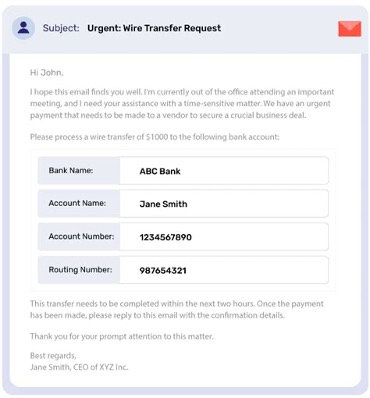
Example 1: A brief email that casually requests a fund transfer while pushing you to act immediatelyclassic Business Email Compromise style. Always verify by phone.
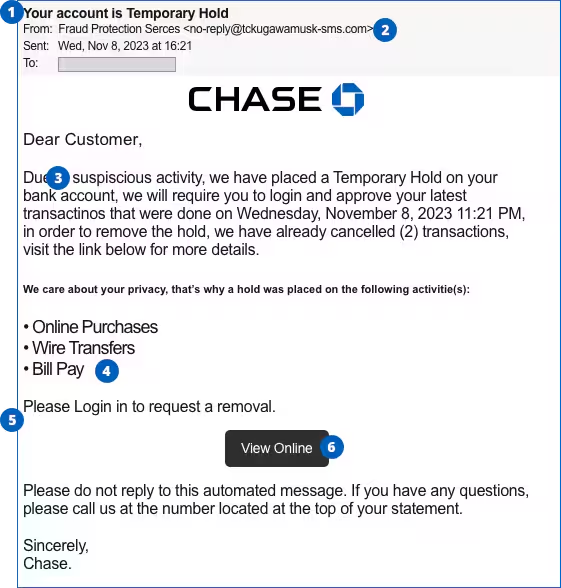
Example 2: A fraudulent bank notice that creates a sense of urgency and includes clickable links. Always hover over links before clicking to see where they really lead.
7. Tools and services that help
Use escrow/title company portals rather than email for wiring details. Numerous firms possess secure portals with two-factor authentication.
8. Short, shareable Wire Fraud Safety script you can utilize
If your closing agent emails new wiring instructions, contact them like this immediately via phone or email.
Here is an example of what you can say: Hi, I got an email with new wiring instructions for my closing. I'm going to hang up and call the number I have on file for your office, and I will confirm your name and extension, and then I will call back." If they pressure you to click a link or call a new number, hang up and call the number you have on file.
And here are my final thoughts as to why wiring funds is normal in home buying, but scammers capitalize on urgency, small changes, and email trust, and why it pays to take the extra 510 minutes to verify everything, which can mean the difference between a smooth closing and an unfixable disaster. If something smells off, stop, call, and double-check.
Be safe and congratulations on this next step toward homeownership!




 Erase note
 You currently have no custom folders