Sign In
Create an account and enjoy all the benefits of HAR.com!
Sign In
Sign in using social account


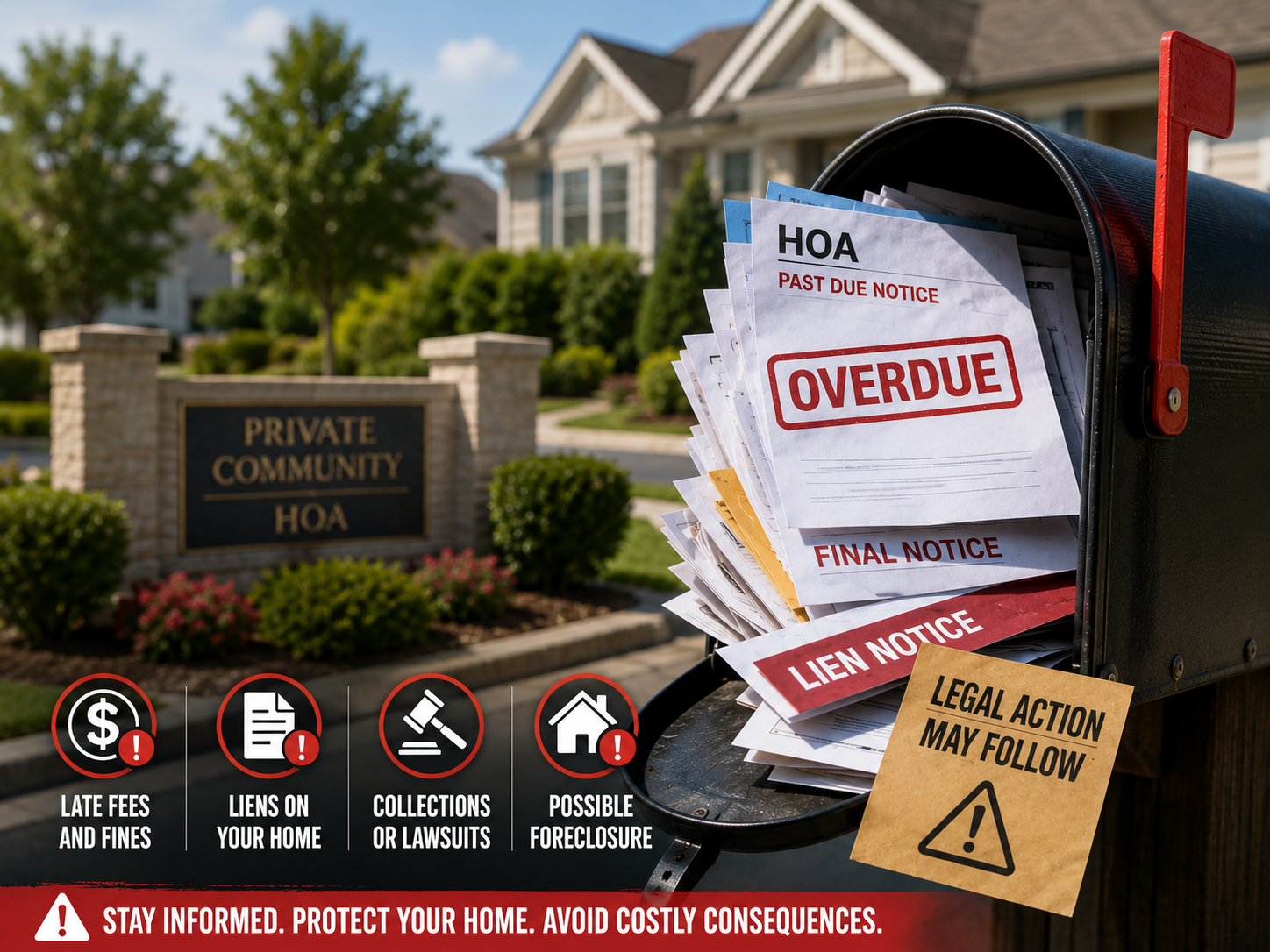
Homeowners’ associations (HOAs) rely on dues and assessments to maintain shared spaces, fund community services, and protect neighborhood standards. For homeowners in an HOA-governed community, these payments are generally an important financial obligation established through the association’s governing documents.
But what happens if HOA fees go unpaid?
Depending on the association’s governing documents and applicable state law, missed HOA payments can result in late fees, interest, collection efforts, loss of certain privileges, property liens, and, in serious cases, foreclosure proceedings.
Understanding how HOA fees work—and what can happen when payments become delinquent—can help homeowners protect their finances, their property, and the neighborhood they call home.
HOA fees and assessments help pay for the operation, maintenance, and long-term needs of a community.
HOA funds may cover landscaping, common-area maintenance, amenities, insurance, utilities, security, and reserve funds.
Missing HOA payments can result in additional fees and increasingly serious collection actions.
Depending on governing documents and applicable law, an HOA may be able to place a lien on a property and, in some circumstances, pursue foreclosure.
Homeowners who anticipate difficulty paying should review their HOA documents and contact the association early rather than ignoring notices.
HOA fees—often called dues or assessments—are payments homeowners make to their homeowners’ association to fund the operation and upkeep of the community.
The exact amount and payment schedule vary by association. Some communities collect dues monthly, while others may collect them quarterly or annually. HOAs may also levy special assessments when additional funds are needed for major repairs, improvements, or unexpected expenses.
HOA payments commonly help cover:
Common Area Maintenance: Upkeep and repairs for shared spaces such as parks, playgrounds, sidewalks, and swimming pools.
Landscaping and Groundskeeping: Lawn care, tree trimming, irrigation, planting, and other landscaping services in common areas.
Exterior Maintenance: In some communities, HOA funds may cover certain exterior repairs, painting, roofing, or other work that helps maintain appearance and protect property values.
Amenities: Maintenance and operation of clubhouses, fitness centers, pools, tennis courts, and other shared facilities.
Security: Depending on the community, fees may help fund gated entrances, security personnel, access-control systems, or surveillance.
Utilities: Some associations pay for water, electricity, trash service, sewer service, or other utilities associated with common areas.
Insurance: HOAs generally maintain insurance for certain common areas, shared structures, and association liabilities.
Reserve Funds: A portion of HOA revenue may be placed into reserves for major repairs, replacements, and future capital projects, helping support the association’s long-term financial stability.
Because these expenses continue regardless of whether every homeowner pays on time, delinquent accounts can affect more than the individual homeowner.
HOA fees generally cannot simply be ignored or waived at a homeowner’s discretion. Whether an association can reduce, defer, or otherwise modify an amount owed depends on its governing documents, policies, and applicable law.
However, homeowners experiencing financial difficulty may have options.
If you are struggling to make an HOA payment, contact the association or management company as early as possible.
Some associations may offer payment plans or other arrangements for delinquent balances. Availability and terms vary, so homeowners should not assume that hardship automatically eliminates the obligation to pay.
In addition to regular HOA dues, an association may levy a special assessment to pay for significant expenses that cannot be adequately covered by its regular operating budget or reserves.
Examples may include major roof repairs, structural work, storm damage, infrastructure improvements, or other substantial community projects.
Whether and how an HOA can impose a special assessment is generally governed by its governing documents and applicable law.
If you have questions about an HOA charge, begin with the association’s declaration, bylaws, rules, collection policy, and other governing documents.
These documents may explain:
When payments are due
When an account becomes delinquent
Applicable late fees or interest
Collection procedures
Payment-plan options
Rules regarding special assessments
The association’s enforcement rights
Understanding these provisions before a payment problem escalates can save considerable time and expense.
An HOA payment becomes delinquent when it remains unpaid beyond the deadline established by the association’s governing documents or applicable rules.
The exact timeline varies. An association may impose a late charge shortly after a missed deadline, while additional collection actions may occur only after further notice or after the balance remains unpaid for a specified period.
Homeowners should never assume they have several months before a missed payment matters. Check the association’s governing documents and any notices you receive to determine the applicable deadlines.
Homeowners may fall behind for many reasons, including:
Financial hardship
Unexpected household expenses
Forgetting a due date
Changes to assessment amounts
Billing or contact-information problems
Disputes over charges
Dissatisfaction with HOA management
A disagreement with the HOA, however, does not necessarily eliminate a homeowner’s payment obligation. If you believe a charge is incorrect, review the governing documents and follow the association’s dispute procedures rather than simply withholding payment.
HOA collection and enforcement laws are not identical everywhere.
State law, association documents, notice requirements, and the type of debt involved can all affect what an HOA may do when an account becomes delinquent.
Homeowners facing substantial delinquent balances, liens, lawsuits, or foreclosure notices may want to consult a qualified attorney familiar with HOA and real estate law in their state.
HOAs typically rely heavily on homeowner assessments to fund their operating budgets.
When a significant number of owners fail to pay, the association may have to compensate for the shortfall. That can affect maintenance, reserves, future assessments, and the overall financial health of the community.
A shortage of operating funds may force an HOA to postpone repairs, reduce landscaping, scale back services, or delay improvements.
Deferred maintenance can eventually create larger and more expensive problems and may negatively affect the community environment.
Reserve funds are generally intended for major repairs, replacements, and other long-term expenses.
If an association must rely heavily on reserves to cover routine operating costs, it may have fewer resources available when major repairs become necessary.
A budget shortfall may ultimately contribute to higher future dues or the need for special assessments, depending on the association’s financial condition and governing documents.
That means chronic non-payment by some owners can potentially create financial pressure for other homeowners as well.
The consequences of unpaid HOA fees can become progressively more serious.
Exactly what happens—and how quickly—depends on the association’s governing documents, collection policies, the amount owed, and applicable law.
Here are some of the most common potential consequences.
A missed payment may result in late fees, interest, or other authorized charges.
Even a relatively small unpaid balance can grow over time, making it harder to bring the account current.
Depending on the community’s rules and applicable law, delinquency may result in suspension of certain privileges, such as access to pools, gyms, clubhouses, or other amenities.
For a homeowner, this can reduce access to benefits that were part of the appeal of living in the community.
If the balance remains unpaid, the HOA may escalate its collection efforts.
Depending on the circumstances, this could include additional notices, involvement of a collection agency or attorney, or legal action to recover the debt.
Collection activity may also add costs to the amount owed when permitted by the governing documents and applicable law. Certain collection activity may affect a homeowner’s credit score, depending on how the debt is handled and reported.
One of the most serious potential consequences of unpaid HOA assessments is a lien against the property.
A lien represents a legal claim associated with a debt owed on the property. An unresolved HOA lien can complicate a future sale or refinance and may need to be addressed before a transaction can proceed.
The rules governing HOA liens—including notice requirements, eligible charges, and enforcement procedures—vary by jurisdiction.
In some circumstances, an HOA lien may ultimately lead to foreclosure proceedings.
Foreclosure is not the result of every late HOA payment, and important legal requirements and limitations may apply. Nevertheless, homeowners should take delinquent HOA notices seriously and act before a relatively manageable balance develops into a much larger legal and financial problem.
Ignoring HOA notices is usually one of the worst approaches.
If you know you will have difficulty making a payment, being proactive gives you a better opportunity to understand your options before additional charges or collection actions accumulate.
Consider taking these steps:
Review your account. Confirm the balance, due dates, and any fees or interest that have been added.
Read your HOA documents. Review the association’s collection policy and governing documents so you understand your rights and obligations.
Contact the HOA or management company. Ask whether payment plans or other arrangements are available.
Get agreements in writing. If the HOA agrees to a payment arrangement, keep written documentation of the terms.
Keep records. Save statements, notices, emails, receipts, and proof of every payment.
Respond to legal notices promptly. A lien, lawsuit, or foreclosure notice should not be ignored.
Seek professional advice when necessary. For substantial balances or legal disputes, consider consulting an attorney familiar with HOA law in your state.
Preventing delinquency is much easier than resolving a growing balance.
If your HOA offers automatic payments, consider enrolling so regular dues are paid without requiring you to remember every deadline.
Always verify that the correct amount was withdrawn, particularly after annual dues or assessments change.
Create reminders several days before each payment is due. This gives you time to resolve account or payment issues before the deadline.
Treat HOA dues as a recurring housing expense alongside your mortgage, property taxes, insurance, utilities, and routine maintenance.
If your association commonly adjusts dues annually, leave some room in your household budget for increases.
Special assessments can sometimes be substantial. Maintaining an emergency fund can help homeowners manage unexpected housing expenses without immediately falling behind.
Review HOA notices and annual budgets so increases do not catch you by surprise.
If you do not understand a new charge, contact the HOA or management company promptly for clarification.
Make sure the association has your current mailing address, email address, phone number, and other required contact information.
Missing an HOA notice because your information is outdated does not necessarily eliminate the underlying obligation.
Understanding the potential effects of late payments can provide an extra incentive to address a payment issue before it grows.
Some communities use online management platforms to handle payments, notices, maintenance requests, and resident communications.
TownSq, for example, is a community-management platform that may be available in participating HOA communities. Depending on the services enabled by the association, homeowners may be able to use the platform to manage payments and stay informed about community matters.
Available features may include:
Payment Management: Online options for managing HOA payments.
Automatic Reminders: Notifications that can help homeowners keep track of upcoming obligations.
Community Communication: Announcements, discussions, and event information that can help foster a sense of belonging.
Maintenance Requests: Tools for submitting and tracking maintenance requests.
Availability and specific features depend on the individual association and its management setup.
HOA fees do more than pay for landscaping or access to community amenities. They help fund the ongoing operation, maintenance, insurance, reserves, and long-term needs of the community.
Falling behind can turn a routine housing expense into a much larger financial problem. Late fees and interest may be followed by collection efforts and, depending on the circumstances and applicable law, a lien or even foreclosure proceedings.
If you are having difficulty paying, act early. Review your HOA documents, communicate with the association, keep careful records, and understand your options before the balance grows.
Staying informed and proactive can help protect both your finances and your home.
For a home used as a personal residence, HOA fees and assessments are generally not deductible as a personal expense for federal income tax purposes.
Different rules may apply when a property is used for rental or business purposes. Tax treatment depends on the circumstances, so homeowners should consult a qualified tax professional for advice specific to their situation.
An HOA board typically develops its budget based on the community’s expected operating expenses, maintenance requirements, insurance costs, reserve needs, contracts, and planned projects.
Special assessments may be considered when the association needs additional funds for significant repairs, improvements, emergencies, or other expenses not adequately covered by the regular budget or reserves.
The procedures an HOA must follow depend on its governing documents and applicable law.
Start by reviewing the HOA’s governing documents, budget information, notices, and any materials explaining the assessment.
Homeowners may also attend board meetings, ask questions, request information available to them under applicable rules, and discuss concerns with the association.
If you believe an assessment was imposed improperly or violates applicable law or the association’s governing documents, consider seeking advice from a qualified attorney rather than simply refusing to pay.
Depending on state law and the HOA’s governing documents, an association may have the right to place a lien on a property for certain unpaid assessments or related charges.
Because lien laws, notice requirements, and homeowner protections vary by jurisdiction, review any lien notice promptly and consider obtaining legal advice if you are unsure of your rights.
In some jurisdictions and circumstances, unpaid HOA assessments can eventually lead to foreclosure proceedings. However, the association must comply with applicable laws, notice requirements, governing documents, and any restrictions on foreclosure.
A foreclosure notice should always be taken seriously. If you receive one, consider speaking with a qualified attorney as soon as possible.




 Erase note
 You currently have no custom folders