Sign In
Create an account and enjoy all the benefits of HAR.com!
Sign In
Sign in using social account


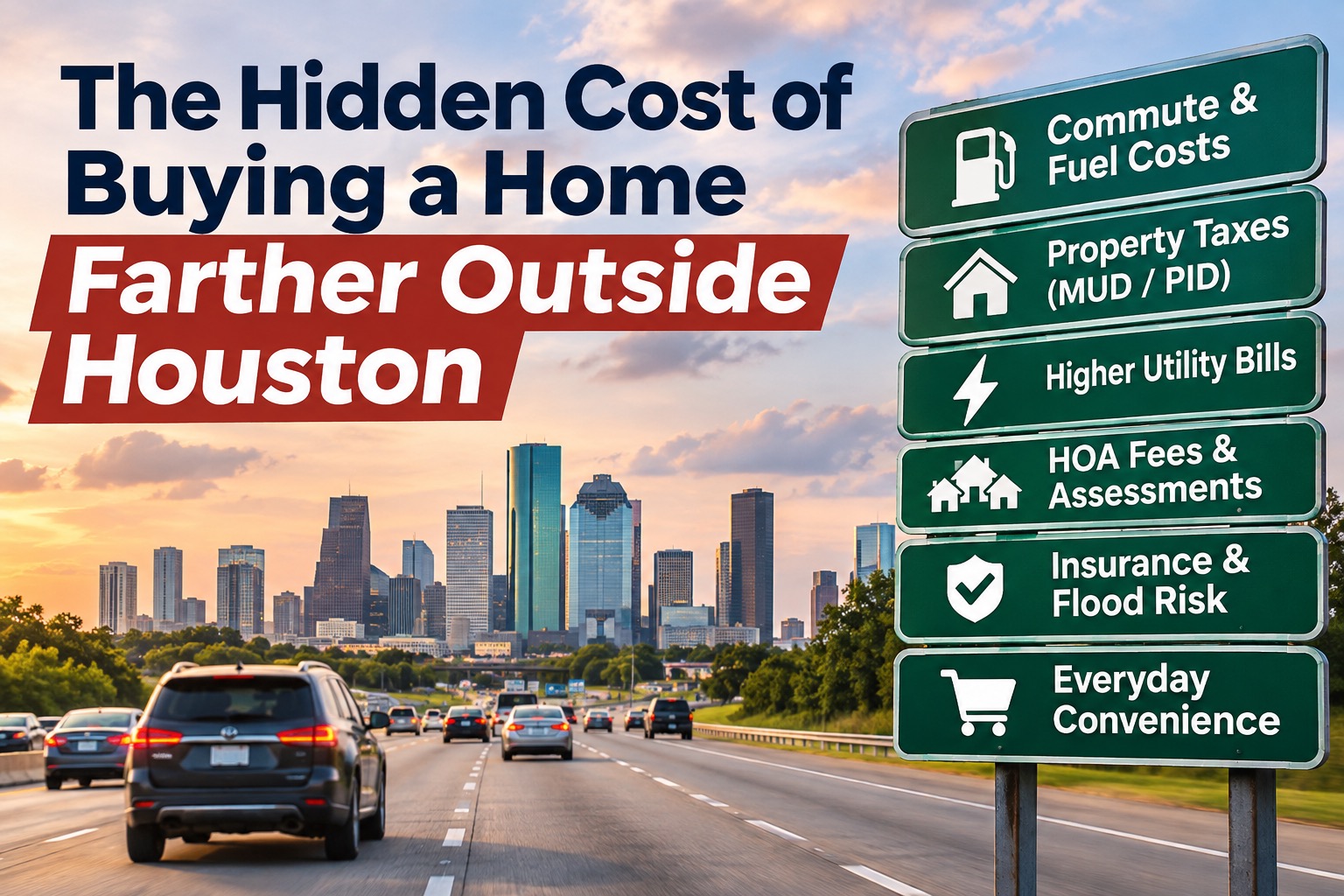
As homebuyers search for more affordable housing in the Greater Houston area, many are expanding their searches beyond the city limits. Communities like Magnolia, Conroe, Fulshear, Rosenberg, and Brookshire offer attractive options, including newer construction, larger lots, and more square footage for the money.
While purchasing farther outside Houston may mean a lower home price, buyers should understand that a less expensive home does not always translate into a lower overall cost of living. Several additional expenses can affect long term affordability.
One of the biggest expenses buyers overlook is transportation. A home that costs $40,000 less may seem like a great deal, but living farther from work can increase everyday expenses.
Consider the following costs:
Fuel: Longer daily commutes mean more frequent trips to the gas station.
Toll roads: Routes such as the Grand Parkway, Hardy Toll Road, and Westpark Tollway can add recurring expenses.
Vehicle maintenance: Additional mileage can lead to more frequent oil changes, tire replacements, and repairs.
Vehicle depreciation: Higher annual mileage can reduce a vehicle's resale value.
Time: Spending an additional hour commuting each day can significantly affect work life balance.
For example, an additional 30 miles of driving per workday adds approximately 7,500 miles annually, assuming 250 commuting days. That extra mileage represents a real expense beyond the monthly mortgage payment.
Property taxes are another important consideration when comparing homes across Greater Houston.
Some newer communities outside Houston are located within Municipal Utility Districts (MUDs) or Public Improvement Districts (PIDs). These districts may help finance infrastructure and public improvements, but they can also create additional costs for homeowners.
Buyers should investigate:
The property's combined tax rate, including applicable special districts.
Whether the community has MUD taxes or PID assessments.
Whether the home qualifies for a residence homestead exemption.
How the estimated tax bill may change after purchasing.
Whether a new construction home's current tax estimate reflects only the land value.
Important: A home's advertised monthly payment may not accurately represent the buyer's future expenses, particularly when new construction tax estimates are based on incomplete improvements.
One of the biggest attractions of suburban living is getting more square footage for the purchase price.
However, larger homes can also mean increased operating expenses.
Common examples include:
Higher electricity costs for heating and cooling.
Increased water usage for larger yards and landscaping.
Additional irrigation system maintenance.
More expensive roof, flooring, and HVAC replacements.
Higher costs for routine cleaning and upkeep.
Some properties outside established municipal service areas may also have private wells, septic systems, or propane equipment that require additional maintenance.
Although newer homes may offer energy efficient features, buyers should still compare expected utility costs based on the home's size, construction, and equipment.
Many suburban neighborhoods offer amenities such as resort style pools, fitness centers, walking trails, playgrounds, and community gathering spaces.
These features can enhance the homeowner experience, but they are often funded through homeowners association dues.
Before purchasing, buyers should review:
Annual or monthly HOA assessments.
Potential special assessments.
Community maintenance responsibilities.
Fees associated with certain amenities.
Restrictions involving landscaping, parking, and property improvements.
A neighborhood with extensive amenities may offer excellent lifestyle benefits, but those costs should be included in the overall housing budget.
Moving farther from central Houston does not automatically eliminate flooding or insurance concerns.
Flood exposure can vary significantly from one neighborhood to another, even within the same suburb.
Buyers should consider:
Reviewing FEMA flood maps and available local flood information.
Researching the property's known flooding history.
Obtaining homeowners insurance quotes before closing.
Evaluating whether separate flood insurance is appropriate.
Understanding that standard homeowners insurance generally does not cover flood damage.
Insurance premiums may also vary based on roof age, construction materials, replacement costs, and other property characteristics.
Living farther outside Houston may provide more privacy, larger properties, and quieter surroundings. However, buyers should also evaluate access to everyday necessities.
Consider the distance to:
Grocery stores and shopping centers.
Hospitals and medical providers.
Schools and childcare facilities.
Restaurants and entertainment.
Major highways and employment centers.
A home that appears affordable may require more frequent driving for errands, appointments, and family activities.
Before deciding between a home closer to Houston and one farther outside the city, buyers should create a realistic monthly comparison.
A home farther outside Houston might offer a mortgage payment that is $250 lower than a comparable property closer to the city. However, that savings could disappear when additional expenses are considered.
For example:
An extra $150 per month in property taxes.
An additional $50 per month in HOA fees.
Approximately $100 more in monthly utilities.
An additional $250 per month in transportation expenses.
In this hypothetical situation, the buyer would spend $550 more each month on these expenses while saving only $250 on the mortgage payment. That creates a net increase of $300 per month, or $3,600 annually.
These figures are illustrative and will vary depending on the property, neighborhood, commute, and household.
This is why buyers should evaluate the complete financial picture rather than focusing exclusively on the listing price.
For many buyers, absolutely. Communities such as Magnolia, Conroe, Fulshear, and Rosenberg can offer excellent opportunities for those seeking additional space, newer homes, and a different lifestyle.
The key is understanding the financial tradeoffs before making a decision.
Buyers who work remotely, have flexible schedules, or prioritize larger properties may find that suburban living makes financial and practical sense. Others may discover that paying more for a home closer to work actually saves money over time.
Buying a home is about more than finding the lowest purchase price. Property taxes, insurance, transportation, utilities, and neighborhood fees all influence what homeowners ultimately spend.
The most affordable home isn't always the one with the lowest price tag. It's the one that fits your overall budget and lifestyle.


 Erase note
 You currently have no custom folders